

What does an SEO content optimizer tool do?
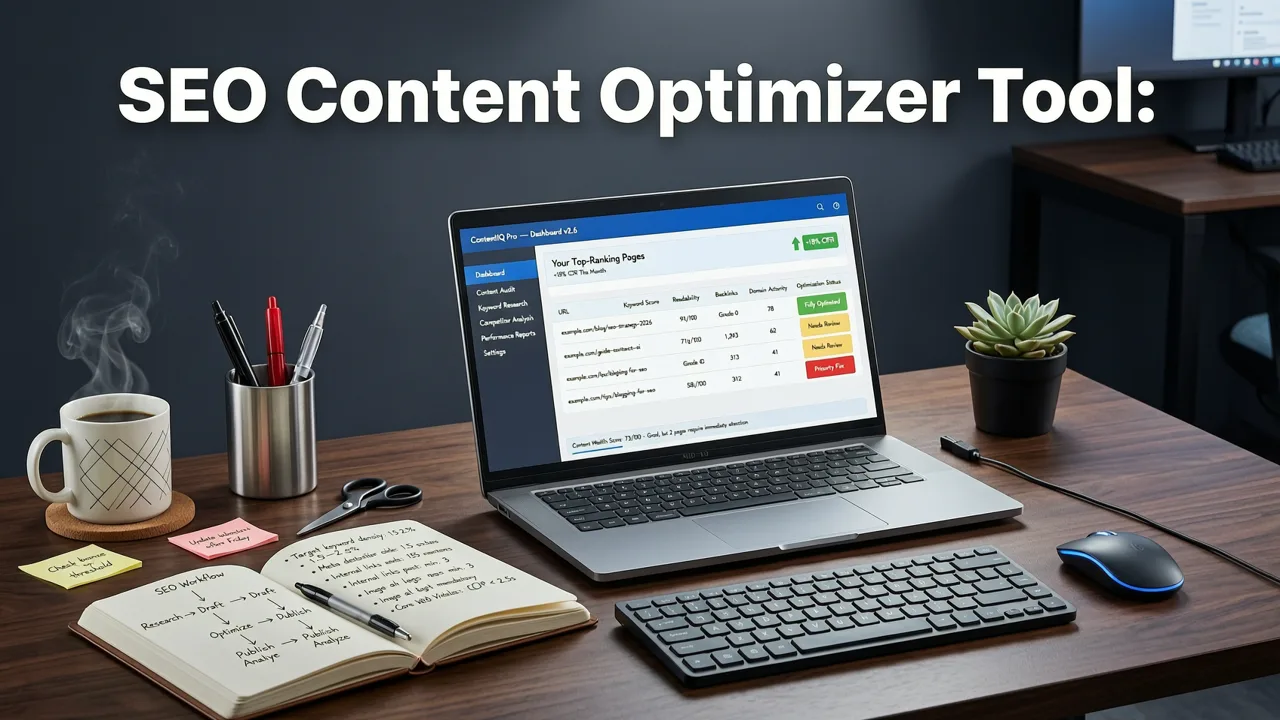
An SEO content optimizer compares your draft with the pages that already rank for your keyword. It scores how fully you cover the topic, suggests missing terms, questions and headings, and checks basics such as title length, so you can close the gaps before you publish or when you refresh an older page.
Below you'll find a no-fluff breakdown of the leading SEO content optimizer platforms, how they compare on features and pricing, and which one fits your workflow — whether you run a lean startup, an ecommerce brand, or a mid-market content team.
Why SEO Content Optimization Matters More in 2026

Google's ranking signals have shifted decisively toward topical depth, user intent alignment, and content usefulness. A page that checks keyword boxes but ignores searcher intent rarely holds position for long. That's why a dedicated SEO content optimizer tool has moved from "nice to have" to table stakes for any team serious about organic growth.
Three forces are driving this shift:
- AI Overviews and zero-click results now absorb a large share of informational queries, meaning your content must earn clicks by being genuinely deeper than the summary.
- Helpful Content signals continue to reward pages that demonstrate first-hand expertise and clear structure.
- Competitor saturation means even strong topics need on-page refinement to break through.
If you're building out your broader organic strategy, our guide on how to improve organic search traffic in 2026 walks through the full framework these tools plug into.
What a Modern SEO Content Optimizer Tool Actually Does

Before comparing products, it helps to define what "content optimization" means in 2026. A mature SEO content optimizer tool handles four jobs:
- Brief generation — pulling top-ranking entities, questions, and subtopics from live SERPs.
- Real-time scoring — giving writers a content grade as they draft, based on NLP and coverage analysis.
- On-page SEO checks — validating title tags, meta descriptions, heading hierarchy, internal links, and schema readiness.
- Post-publish monitoring — flagging content decay and suggesting refreshes.
Tools that only do one of these — say, keyword density checks — are relics. The 2026 winners do all four in one interface.
Top SEO Content Optimizer Tools Compared
Here's a side-by-side look at six widely used platforms. Pricing reflects annual plans as of mid-2026; check current rates on each vendor's site.
| Tool | Best For | AI Briefs | Real-Time NLP Score | Starting Price (USD/mo) |
|---|---|---|---|---|
| Surfer SEO | Content teams & agencies | Yes | Yes | 89 |
| Frase | Solo marketers & small teams | Yes | Yes | 45 |
| Clearscope | Enterprise & high-volume publishers | Yes | Yes | 170 |
| MarketMuse | Topical authority & content planning | Yes | Yes | 149 |
| NeuronWriter | Budget-conscious SEOs | Yes | Yes | 29 |
| Scalenut | AI-first writers & ecommerce | Yes | Yes | 39 |
Surfer SEO
Surfer remains the default for agencies managing dozens of pages per month. Its Content Editor gives writers a live score, suggested term frequencies, and structural guidance pulled from the current top 10. The Audit feature lets you score existing pages against competitors — useful for content refreshes. Surfer also integrates directly with Google Docs and WordPress, which cuts friction for distributed teams.
Frase
Frase is the strongest pick if you need a single tool that handles research, writing, and optimization. Its AI outline generator pulls questions from People Also Ask and competitor headings, then scores your draft against the SERP. For small teams wearing multiple hats, Frase's all-in-one workflow is hard to beat at its price point.
Clearscope
Clearscope is built for teams that publish at scale and need consistent quality. Its grading system is stricter than most, which tends to produce stronger content — but it can feel rigid for long-form thought leadership. Clearscope shines when you have a large editorial team and need a single source of truth for content standards.
MarketMuse
MarketMuse differentiates itself with topic clustering and content gap analysis. If your goal is topical authority rather than one-off page wins, MarketMuse maps your entire site's coverage and tells you which pieces to write next. It's less of a writer's tool and more of a strategist's tool — pair it with a separate editor if your team needs hands-on drafting support.
NeuronWriter
NeuronWriter is the budget-friendly option that punches above its weight. It uses NLP-based scoring similar to Clearscope, offers competitor analysis, and includes a simple internal-linking suggestion engine. For freelancers and small agencies, it covers much of what premium tools do at a fraction of the cost.
Scalenut
Scalenut leans heavily into AI-assisted writing, generating full drafts from briefs and then optimizing them in the same interface. It's a strong fit for ecommerce brands producing large volumes of product and category content. The trade-off is that AI-first output sometimes needs a human pass for brand voice and E-E-A-T signals.
How to Choose the Right SEO Content Optimizer Tool
The "best" tool depends on your team size, workflow, and goals. Ask yourself these five questions:
- Who writes the content? In-house writers, freelancers, or AI with human editing? Tools like Clearscope work best with trained writers; Scalenut suits AI-heavy workflows.
- How many pages per month? Under 20? Frase or NeuronWriter is plenty. Over 50? Surfer or Clearscope justify their cost.
- Do you need topic planning? If yes, MarketMuse's clustering engine is worth the premium.
- What CMS do you use? Check native integrations — Surfer and Frase both plug into WordPress and Google Docs; others rely on copy-paste.
- What's your budget per seat? Ranges from $29/mo (NeuronWriter) to $170+/mo (Clearscope). Factor in team seats, not just base plans.
How to Use a Content Optimizer Tool Effectively
Buying the tool is the easy part. Getting results requires a repeatable process:
Step 1: Start With a Strong Keyword Brief
Don't just feed the tool a keyword and accept the auto-generated brief. Review the suggested entities, check whether the top-ranking pages actually cover them, and add any first-hand insights only your team can provide. The tool's brief is a starting point, not the final word.
Step 2: Write for Humans, Score for Search
Aim for a content score in the 70–85 range. Chasing 100 often leads to keyword-stuffed, unreadable copy. Google's NLP systems in 2026 reward natural language that covers topics comprehensively — not pages that mechanically insert every suggested term.
Step 3: Optimize On-Page Elements Separately
Content scores don't cover everything. Manually review your title tag, meta description, URL slug, heading hierarchy, image alt text, and internal links. Our breakdown of organic traffic vs referral traffic in GA4 explains why on-page quality directly affects which traffic sources you actually capture.
Step 4: Add Structured Data
Use Schema.org markup to help search engines understand your content type — FAQ, HowTo, Article, Product, or Review schema as appropriate. Most optimizer tools don't handle schema, so this step usually lives outside the tool.
Step 5: Monitor and Refresh
Publishing is not the finish line. Re-run your pages through the optimizer every 90 days. SERPs shift, competitors update, and content decay is real. Pair this with the best GA4 reports for SEO in 2026 to spot pages losing traffic before they fall off the first page entirely.
Common Mistakes to Avoid
- Over-optimizing for the score. A perfect tool score does not guarantee a first-page ranking. Write for readers first.
- Ignoring search intent. If the SERP shows product pages and you're writing a blog post, no tool will save you.
- Skipping the human edit. AI-generated drafts need fact-checking, brand voice alignment, and E-E-A-T reinforcement.
- Treating the tool as a replacement for strategy. Optimization without keyword research and topical planning is just polishing random pages.
How These Tools Fit Into a Broader SEO Strategy
A content optimizer tool is one layer of a full organic strategy. It works best when paired with solid technical SEO, a clear internal linking structure, and accurate performance measurement. For example, understanding whether your growth is coming from organic search vs paid search in GA4 tells you whether your content investment is actually paying off — or whether traffic is just shifting between channels.
Combine content optimization with technical audits, link building, and ongoing performance tracking. The tool does the heavy lifting on individual pages; the strategy makes sure those pages drive real business results.
Final Verdict: Which SEO Content Optimizer Tool Should You Pick?
There is no single "best" SEO content optimizer tool — only the best tool for your team. Here's the quick decision matrix:
- Agency or content team scaling production: Surfer SEO or Clearscope.
- Solo marketer or small team on a budget: Frase or NeuronWriter.
- Enterprise publisher focused on topical authority: MarketMuse.
- Ecommerce brand producing high volumes of AI-assisted content: Scalenut.
Whichever you choose, remember: the tool amplifies your strategy — it doesn't replace one. Start with clear goals, build a repeatable workflow, and measure results against business outcomes, not just content scores.


