

How to Improve Organic Search Traffic in 2026: A Practical Guide
If you want to know how to improve organic search traffic in 2026, the short answer is this: build topical authority, align every page with clear searcher intent, and make sure your technical foundation is flawless. The longer answer is a disciplined framework that combines content strategy, AI-assisted production, technical SEO, and earned authority — executed consistently over months, not weeks.
Organic growth in 2026 is harder than it was even two years ago. Google’s AI Overviews, zero-click results, and evolving ranking signals mean that simply publishing more content is no longer enough. Brands that win organic visibility are the ones that treat SEO as a compound system: every asset reinforces the next, every technical improvement compounds traffic, and every piece of content earns its place through depth, accuracy, and genuine usefulness.
This guide walks you through a practical playbook for growing sustainable organic traffic: the framework, the priorities, and the tactical steps that move the needle — not recycled advice that stopped working years ago.
Why Organic Traffic Growth Is Harder — and More Valuable — Than Ever
Before diving into tactics, it’s worth understanding why organic traffic matters more now than ever, even as it gets more difficult to earn.
Paid channels are getting more expensive. Privacy changes have reduced the targeting precision of social and display ads. Meanwhile, Google’s search results page is more competitive than ever, with AI-generated summaries, featured snippets, and knowledge panels absorbing clicks that used to go to organic listings.
Yet the brands that still invest in organic SEO are reaping outsized rewards. Why? Because organic traffic compounds. A well-optimized page can drive qualified visitors for years. Organic visitors tend to have higher intent, longer session durations, and better conversion rates than traffic from most other channels. And unlike paid media, you own the asset — no algorithm change can instantly shut off your traffic if your foundation is strong.
The 2026 Organic Landscape at a Glance
| Factor | Impact on Organic Traffic |
|---|---|
| AI Overviews & zero-click results | Reduces click-through for simple queries; rewards in-depth, authoritative content |
| Google’s helpful content & quality signals | Prioritizes first-hand expertise, original research, and user satisfaction |
| AI-generated content saturation | Makes differentiation through depth, data, and human insight essential |
| Core Web Vitals & page experience | Technical performance remains a baseline ranking requirement |
| E-E-A-T expectations | Demand for demonstrated expertise, author identity, and citations is higher |
The 2026 Organic Traffic Growth Framework
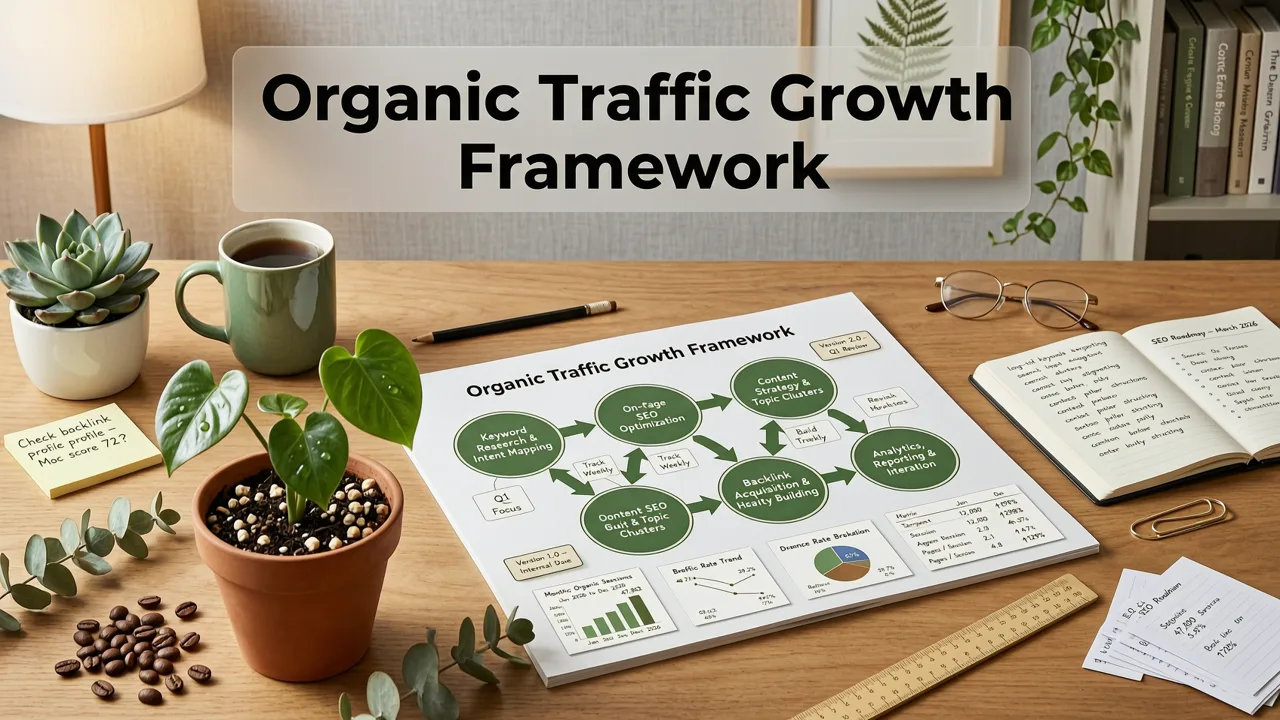
Improving organic search traffic isn’t about one silver bullet. It’s about executing a connected system. Here’s the framework we recommend:
- Audit — Understand where you stand today (technical health, content gaps, backlink profile).
- Strategize — Map topic clusters around searcher intent, not just keywords.
- Create — Produce content that is genuinely more useful than what already ranks.
- Optimize — Apply on-page, technical, and schema optimizations to every asset.
- Promote — Earn links, build authority, and distribute content where your audience lives.
- Measure & Iterate — Track what’s working, double down, and retire what isn’t.
Let’s break each step down.
1. Audit Your Current SEO Foundation
You can’t improve what you don’t measure. Before creating new content or chasing new keywords, you need a clear picture of your current organic performance.
Technical Health Check
Start with a comprehensive technical audit. Crawl errors, slow page speeds, broken internal links, duplicate content, and missing structured data can silently suppress your rankings. In 2026, Google’s rendering pipeline and indexing systems are more sophisticated than ever — but they still rely on clean, accessible HTML and fast load times. For a complete walkthrough, use our Technical SEO Audit Checklist to identify and prioritize fixes.
Content Inventory
Map every page on your site. Identify which pages drive traffic, which convert, and which are dead weight. Thin, outdated, or duplicate content doesn’t just fail to rank — it can actively drag down your site’s overall quality signals. Pruning or consolidating weak pages is often one of the fastest ways to improve organic performance.
Backlink Profile Review
Check your referring domains, anchor text distribution, and link velocity. A healthy backlink profile shows natural growth and relevance. Toxic or spammy links should be disavowed. For a deeper look at building authority, see our guide on how to grow organic traffic in 2026.
2. Build Topic Clusters Around Searcher Intent
Keyword-by-keyword SEO is dead. In 2026, Google ranks topics, not just individual pages. The most effective way to improve organic search traffic is to organize your content into topic clusters that comprehensively cover a subject.
What Is a Topic Cluster?
A topic cluster is a group of interlinked pages built around a central "pillar" page and a set of supporting "cluster" pages. The pillar page covers the broad topic at a high level, while each cluster page dives deep into a specific subtopic. Internal links connect them all, signaling to Google that your site is a comprehensive authority on the subject.
How to Build One
- Choose a pillar topic that aligns with your core business offering and has meaningful search volume.
- Research subtopics using keyword tools, "People Also Ask" data, and competitor analysis.
- Map searcher intent for each subtopic — is the user looking to learn, compare, buy, or troubleshoot?
- Create the pillar page as a definitive, well-structured resource (2,000+ words is a good starting point for competitive topics).
- Write cluster pages that each answer a specific question or solve a specific problem, linking back to the pillar.
- Interlink strategically — every cluster page links to the pillar, and the pillar links to every cluster page.
This structure doesn’t just help Google understand your content — it helps users navigate from awareness to decision, which improves engagement signals that feed back into rankings.
3. Create Content That Earns Its Ranking
In 2026, the bar for ranking is higher than ever. Google’s quality systems are designed to surface content that demonstrates genuine expertise, originality, and usefulness. Here’s what that means in practice.
Depth Over Volume
Publishing 50 thin blog posts will never outperform publishing 5 deeply researched, genuinely helpful articles. Every piece of content should answer the searcher’s question more completely, more clearly, and more credibly than what currently ranks.
First-Hand Experience & Original Data
Google’s guidance on helpful content asks whether a page shows first-hand expertise. If you’re writing about a product you’ve tested, a strategy you’ve implemented, or data you’ve collected, say so. Include screenshots, case studies, original research, and specific examples. Generic, AI-generated content that says nothing new won’t cut it — for more on navigating this, read our guide to AI content for SEO.
Match the Format to the Intent
Not every query deserves a 3,000-word guide. Some searchers want a quick answer. Others want a comparison table. Others want a step-by-step tutorial. Study the current SERP for your target keyword and match the format that’s already winning — then do it better.
Content Quality Checklist
| Element | What to Check |
|---|---|
| Accuracy | Are all claims factually correct and up to date for 2026? |
| Originality | Does this content offer something the top 5 results don’t? |
| Readability | Is the language clear, scannable, and free of jargon? |
| Visual aids | Are there images, tables, or diagrams that improve understanding? |
| Authorship | Is the author clearly identified with relevant credentials? |
| Citations | Are external sources linked and properly attributed? |
4. Optimize On-Page SEO & Technical Signals
Great content still needs great optimization to rank. On-page SEO in 2026 goes far beyond stuffing keywords into title tags.
Title Tags & Meta Descriptions
Your title tag is the single most important on-page ranking signal. Make it compelling, include your target keyword naturally, and keep it under 60 characters. Meta descriptions don’t directly affect rankings, but they influence click-through rate — treat them as ad copy.
Header Structure
Use a clear heading hierarchy (H1 → H2 → H3) to organize your content. Headers help both users and search engines understand the structure and key points of your page. Include semantic variations of your target keyword in subheadings where natural.
Internal Linking
Every page should have contextual internal links to related content. This distributes link equity, helps Google discover and understand your content, and keeps users engaged. Use descriptive anchor text — not "click here."
Structured Data & Schema
Implement structured data wherever relevant. Article schema, FAQ schema, HowTo schema, and product schema can help Google understand your content and may earn you enhanced search results. For the official reference, see Schema.org and Google’s Search Central documentation.
Core Web Vitals & Page Experience
Page speed, mobile usability, and visual stability remain ranking factors. Optimize images, minimize render-blocking resources, use modern image formats, and ensure your site loads quickly on mobile devices. A fast, stable site improves both rankings and user satisfaction.
5. Earn Authority Through Link Building & Digital PR
Backlinks remain one of the strongest ranking signals in 2026 — but the quality bar is higher than ever. A single link from a relevant, authoritative site is worth more than hundreds of low-quality directory links.
What Works in 2026
- Digital PR & newsworthy content — Original research, industry surveys, and data-driven stories that journalists and publishers want to cite.
- Expert contributions & guest posts — Writing for authoritative publications in your niche, with a focus on genuine value (not link exchange).
- Resource page link building — Creating genuinely useful tools, calculators, or guides that resource curators want to include.
- Broken link building — Finding broken links on relevant sites and offering your content as a replacement.
- Podcast & video appearances — Getting featured on industry podcasts or YouTube channels often results in high-quality backlinks.
What to Avoid
Paid link schemes, PBNs, automated link building, and irrelevant guest posts are more dangerous than ever. Google’s link spam systems are sophisticated, and the penalty risk far outweighs any short-term gain.
6. Leverage Local SEO (If Applicable)
If you serve customers in specific geographic areas, local SEO is a critical component of your organic strategy. Local search results have unique ranking factors — proximity, Google Business Profile optimization, local citations, and reviews all play a role.
For a complete local strategy, check out our Local SEO for Small Business: 2026 Strategy Guide.
7. Measure, Analyze & Iterate
SEO is not a set-it-and-forget-it discipline. The brands that improve organic search traffic consistently are the ones that measure what’s working and double down on it.
Key Metrics to Track
- Organic traffic — Total sessions from search engines (segment by page, topic cluster, and intent).
- Keyword rankings — Track target keywords and their movement over time.
- Click-through rate (CTR) — Low CTR despite good rankings often signals title tag or meta description issues.
- Engagement signals — Time on page, scroll depth, and return-to-SERP rate indicate content quality.
- Conversions — Ultimately, organic traffic should drive business results. Track leads, signups, or sales attributed to organic.
- Backlink growth — Monitor new referring domains and the quality of links earned.
When to Pivot
If a topic cluster isn’t gaining traction after 3–6 months, reassess. Is the content truly better than what ranks? Is the topic aligned with real demand? Are technical issues holding you back? Don’t be afraid to refresh, consolidate, or retire content that isn’t performing.
Common Mistakes That Kill Organic Growth
Even experienced marketers make these mistakes. Avoid them:
- Chasing algorithms instead of users. Build for your audience first; the rankings follow.
- Ignoring search intent. Ranking for a keyword means nothing if your page doesn’t satisfy what the searcher actually wants.
- Publishing without promoting. Great content that nobody knows about won’t earn links or traffic.
- Neglecting technical SEO. No amount of great content can overcome a site that Google can’t crawl or index properly.
- Expecting overnight results. Organic growth is a compound process. Most meaningful results take 4–12 months.
How Long Does It Take to Improve Organic Traffic?
There’s no universal timeline, but here’s a realistic expectation for most businesses executing the framework above:
- Months 1–2: Technical fixes, content audit, and strategy development.
- Months 3–4: New content published, on-page optimizations applied, early ranking movements.
- Months 5–8: Measurable traffic growth as content gains traction and earns links.
- Months 9–12+: Compound growth as topical authority builds and more pages rank.
Patience and consistency are the real competitive advantages in 2026 SEO.
Final Thoughts: Organic Traffic Is a Long-Term Asset
Learning how to improve organic search traffic in 2026 isn’t about hacks or shortcuts. It’s about building a system that earns visibility through genuine quality, technical excellence, and strategic consistency. The brands that invest in this system today will own an asset that drives compounding returns for years to come.


