

Why a Dedicated Ecommerce Keyword Planner Tool Matters in 2026
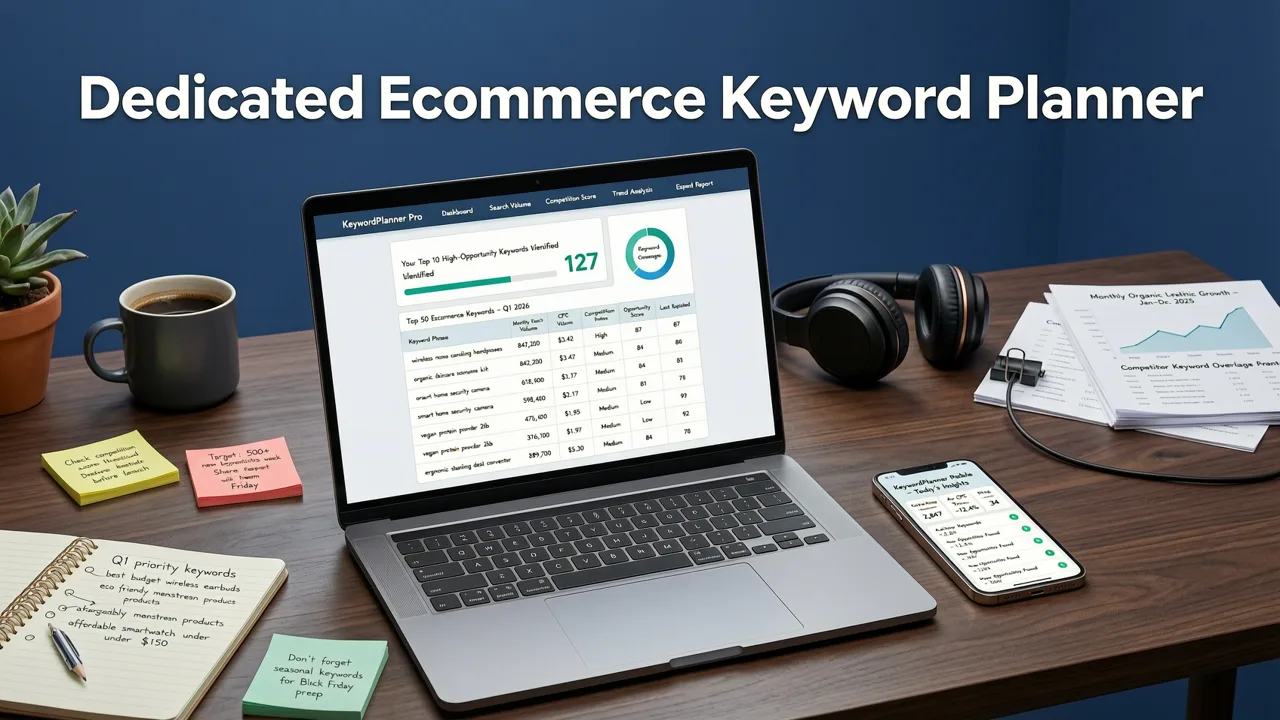
If you are scaling an online store in 2026, relying on generic search volume data is a fast track to zero-click dead ends. The right ecommerce keyword planner tool does more than suggest high-traffic terms; it maps buyer intent directly to your product catalog, clusters semantic variations, and aligns with AI-driven search behaviors.
Modern search engines prioritize semantic search optimization and user intent over exact-match queries. For online retailers, this means your product pages, category hubs, and buying guides must be strategically aligned with the specific stages of the customer journey. Generic SEO software often fails to grasp the nuances of SKU-level targeting, product variants, and commercial transactional intent. A specialized ecommerce SEO software solution bridges this gap, turning raw search data into actionable, revenue-generating site architecture.
Top Ecommerce Keyword Planner Tool Options Compared

Selecting the right platform depends on your catalog size, technical resources, and specific growth goals. Below is a breakdown of the leading options dominating the market this year.
Ahrefs: The All-in-One Powerhouse for Large Catalogs
Ahrefs remains a dominant force for comprehensive product keyword research. Its standout feature for ecommerce brands is the advanced keyword clustering algorithm, which automatically groups semantically related terms into topic clusters. This is critical for category page optimization, ensuring that your main hub pages capture broad commercial queries while sub-pages target specific long-tail variations. Ahrefs also provides deep competitor gap analysis, allowing you to see exactly which product keywords your rivals are ranking for that you are currently missing.
Semrush: Best for Buyer Intent Mapping and Competitor Tracking
Semrush excels in buyer intent mapping. Its Keyword Magic Tool includes robust intent filters that categorize queries as informational, navigational, commercial, or transactional. For ecommerce brands, isolating the commercial and transactional intent keywords is vital for prioritizing product page updates. Furthermore, Semrush’s integration with listing ads and shopping campaigns provides a unified view of how your organic product keyword strategy complements your paid retail media efforts.
Mangools: The Lean Choice for Startups and Niche Stores
For newer brands or niche ecommerce stores operating on tighter budgets, Mangools offers a highly accessible entry point. Its KWFinder tool is exceptionally user-friendly and provides accurate difficulty scores for long-tail product queries. While it lacks the deep enterprise-level clustering of Ahrefs, it is highly effective for identifying low-competition, high-conversion product keywords that larger competitors often overlook. It is an excellent choice for brands looking to build initial topical authority without overwhelming their team.
Surfer SEO: Bridging Keyword Planning and On-Page Optimization
Surfer SEO approaches keyword planning from a content-first perspective. Once you have identified your target product keywords, Surfer’s Content Editor provides real-time NLP (Natural Language Processing) recommendations to ensure your product descriptions and category copy meet the semantic density required to rank in 2026. It is particularly useful for optimizing the text-heavy elements of an ecommerce site, such as buying guides, comparison articles, and detailed product specifications, ensuring they align perfectly with Google Search Central documentation guidelines for helpful content.
Key Features to Look for in an Ecommerce Keyword Planner Tool

When evaluating platforms, do not just look at the total keyword database size. Focus on features that directly impact online retail SEO and catalog management.
- Intent Classification: The tool must accurately separate informational queries (e.g., "how to clean leather boots") from transactional ones (e.g., "buy men's leather boots size 10").
- Automated Clustering: Manual grouping is unscalable for stores with thousands of SKUs. Native clustering ensures you do not accidentally cannibalize your own rankings by targeting the same keyword on multiple product pages.
- SERP Feature Tracking: Ecommerce queries are heavily dominated by AI overviews, shopping carousels, and video snippets. Your tool should track visibility across these specific SERP features, not just standard organic blue links.
- Integration Capabilities: The ability to export data directly into your CMS or PIM (Product Information Management) system streamlines the workflow from keyword discovery to on-page implementation.
How to Build an Ecommerce Keyword Strategy Using Your Tool
Having the right data is only half the battle. The execution of that data dictates your organic revenue. Follow this workflow to transform raw keyword lists into a structured site architecture.
Step 1: Map Keywords to the Buyer Journey
Not all keywords are ready for a product page. Map your discovered terms to the three primary stages of the buyer journey:
- Awareness (Informational): Target these with blog content, buying guides, and educational resources. Example: "best running shoes for flat feet 2026".
- Consideration (Commercial): Target these with comparison pages, category landing pages, and listicles. Example: "Nike vs Brooks running shoes".
- Decision (Transactional): Target these directly on your product detail pages (PDPs) and bottom-of-funnel category pages. Example: "buy Brooks Ghost 15 men's black".
Step 2: Cluster for Topic Authority
Once mapped, use your tool's clustering feature to build hub-and-spoke models. Your main category page acts as the hub, targeting the highest-volume head terms. The subcategories and individual product pages act as spokes, targeting the specific long-tail variations. This internal linking structure passes link equity efficiently and signals to search engines that your site possesses comprehensive topical authority. For deeper insights on structuring this architecture, review our guide on how to grow organic traffic with a 5-pillar framework.
Visual Comparison: Ecommerce Keyword Planner Tool Features
Use the table below to quickly compare how the top platforms handle the specific demands of online retail SEO.
| Platform | Intent Mapping | Keyword Clustering | Ecommerce Filters | Best For |
|---|---|---|---|---|
| Ahrefs | Advanced | Native & Automated | High | Large catalogs & enterprise brands |
| Semrush | Granular | Manual & Assisted | Medium | Integrated paid & organic retail strategies |
| Mangools | Basic | Manual | Low | Startups & niche boutique stores |
| Surfer SEO | Content-Focused | Content-Based | Medium | Optimizing product descriptions & guides |
Integrating Keyword Planning with Technical and Performance Tracking
A flawless keyword strategy will fail if the underlying site infrastructure cannot support it. Once your ecommerce keyword planner tool has identified your target terms, you must ensure your site is technically capable of rendering them for search engines.
This means validating your site architecture, ensuring rapid page load speeds for product pages, and implementing proper Schema.org structured data reference markup so search engines understand your product pricing, availability, and reviews. Conducting a rigorous technical SEO audit checklist ensures that no crawl errors or indexing blocks are preventing your newly optimized product pages from being discovered.
Finally, you must measure the impact. Relying on outdated analytics methods will obscure your true ROI. You need to configure your tracking to attribute organic sessions directly to specific product SKUs and category pages. Learning how to track organic keyword performance in GA4 allows you to connect search intent data with actual conversion events, proving the revenue value of your keyword strategy.
Conclusion: Choosing Your Path to Organic Growth
The landscape of online retail SEO demands precision, semantic understanding, and a tool that speaks the language of ecommerce. Whether you choose the enterprise depth of Ahrefs, the intent granularity of Semrush, the lean efficiency of Mangools, or the content optimization of Surfer SEO, the goal remains the same: aligning your catalog with exactly what your customers are searching for.
If you are just launching and need to build a cost-effective foundation, explore our recommendations for the best SEO tools for startups. For established brands ready to scale their organic visibility and dominate their niche, partnering with a specialized agency can accelerate your results. RankOnPilot helps ecommerce brands transform keyword data into sustainable, long-term revenue growth through technical precision and AI-powered content strategies.


