

Technical SEO Audit Checklist for 2026
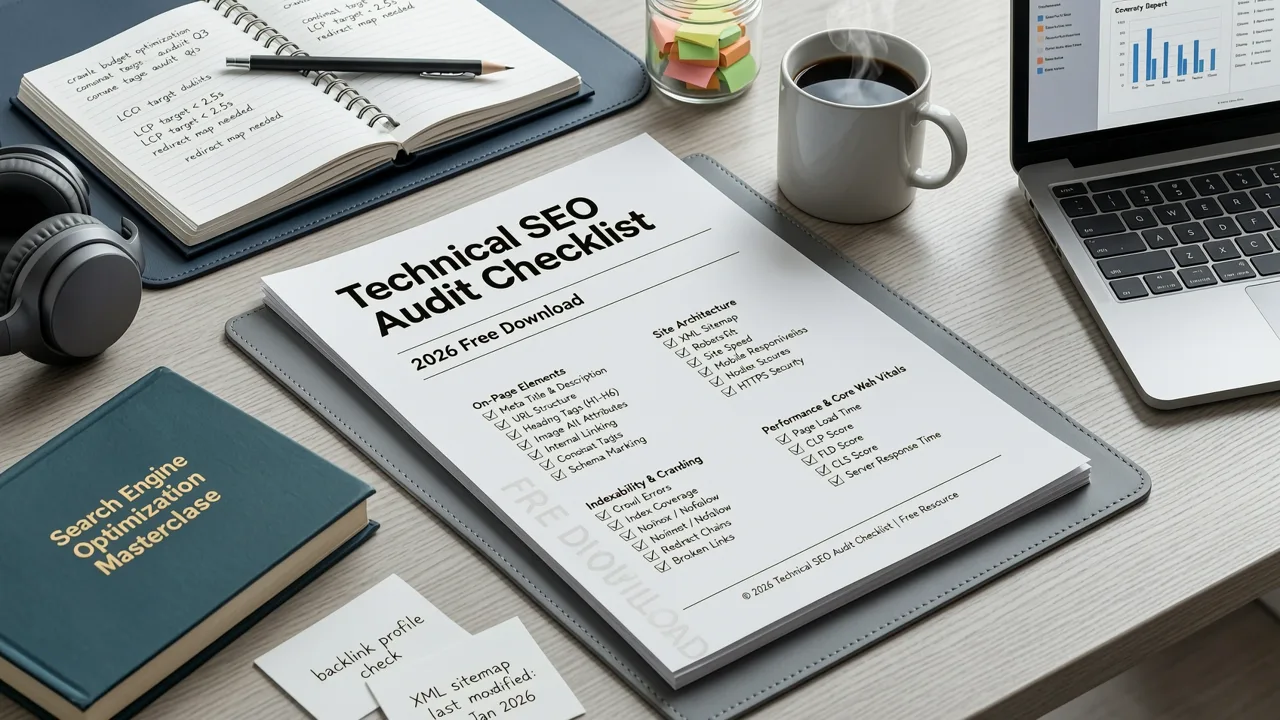
If you’re running a technical SEO audit in 2026, you’re not just checking for broken links or missing sitemaps—you’re validating whether your site meets Google’s evolving standards for page experience, crawl resilience, indexing precision, and AI-readiness. A modern technical SEO audit is no longer a one-time cleanup; it’s a continuous health assessment aligned with how search engines actually render, understand, and prioritize content today.
This Technical SEO Audit Checklist follows Google’s current Search Central guidance. Below, you’ll find a prioritized, tool-agnostic checklist you can work through step by step.
Key points
- Start where Google starts, with crawling, then check indexing, page experience, structured data and security.
- Crawling: check robots.txt in Search Console’s robots.txt report, fix unexpected 4xx and 5xx responses, and keep redirect chains short.
- Indexing: use the Page indexing report, give every page one canonical URL, and use noindex rather than robots.txt to keep pages out of search.
- Page experience: aim for LCP within 2.5 seconds, INP under 200 milliseconds and CLS under 0.1, measured on real users.
- Fix high-impact, low-effort problems first, and audit again after a migration, a redesign or a sudden drop in traffic.
Why Your 2026 Technical SEO Audit Must Go Beyond Basics

In 2026, technical SEO isn’t about “fixing what’s broken.” It’s about proactively aligning infrastructure with three foundational shifts:
- Google’s increased reliance on real-user signals — Google “highly recommend[s]” good Core Web Vitals for success with Search: LCP, INP (Interaction to Next Paint) and cumulative layout shift (CLS), measured on real users’ devices. And since mobile-first indexing finished in 2023, Google indexes every site as its smartphone crawler sees it.
- Indexing velocity & accuracy — Google crawls a page, queues it for rendering, then indexes it, and a page may wait in the render queue “for a few seconds, but it can take longer than that.” Misconfigured hydration, deferred rendering or unoptimized resource loading can delay indexing or leave content out.
- AI-readiness of site architecture — Search engines increasingly use LLM-derived signals to assess content coherence, entity depth, and navigational logic. Pages lacking semantic structure, consistent schema, or contextual linking underperform—not because they’re technically invalid, but because they’re uninterpretable at scale.
Skipping any of these layers means your content—no matter how well-written or keyword-optimized—will struggle to earn visibility, especially against competitors who’ve hardened their technical foundations.
The 2026 Technical SEO Audit Checklist (Prioritized)

This checklist starts where Google starts, with crawling, then moves to indexing, page experience, structured data and security. Each item includes its purpose, how to verify it, and priority level (High/Medium/Low). We recommend completing High-priority items before launch or major content refreshes.
1. Crawl Health & Accessibility (High Priority)
Before anything gets indexed, Google must be able to discover and access your pages reliably.
- Robots.txt validation: Confirm no critical directories (e.g.,
/wp-admin/,/search/) are accidentally blocked—and that staging environments aren’t publicly accessible via robots.txt. Check it in Search Console’s robots.txt report, and test single URLs with the URL Inspection tool. - Crawl budget efficiency: Identify and consolidate thin, duplicate, or low-value pages (e.g., tag archives, session IDs, filtered product listings). Prioritize canonicalization and
noindexover blocking via robots.txt: a disallowed URL can still be indexed if other sites link to it. - HTTP status integrity: Scan for unexpected 4xx/5xx responses on key pages (homepage, category hubs, top-performing blog posts). Pay special attention to soft 404s—pages returning 200 status but displaying “Page not found” content.
- Redirect chain hygiene: Limit chains to ≤ 2 hops. Google’s crawlers follow up to 10 redirect hops, but every hop adds a round trip for crawlers and visitors. Audit with Screaming Frog or Lumar (formerly DeepCrawl).
2. Indexing Accuracy & Control (High Priority)
Getting crawled ≠ getting indexed. Many sites suffer from unintentional index bloat—or worse, critical pages being excluded without notice.
- Page indexing report review: In Google Search Console (GSC), analyze the Page indexing report (formerly Index Coverage) for: Duplicate, Google chose different canonical than user, Discovered – currently not indexed, and Excluded by ‘noindex’ (verify intent). Cross-reference with your sitemap submission dates.
- Canonical tag consistency: Ensure every page declares exactly one canonical URL—and that it points to the preferred, indexable version (e.g.,
https://example.com/product/, nothttps://www.example.com/product/?ref=blog). Watch for self-referencing mismatches between HTTP/HTTPS or www/non-www. - Sitemap validity & freshness: Validate XML sitemaps using sitemaps.org guidelines. Confirm lastmod timestamps reflect actual content updates (not static generation time). For dynamic sites, implement incremental sitemap updates—especially for blogs and product catalogs.
- Noindex enforcement: Verify sensitive areas (e.g., admin portals, internal search results) carry a
noindexrule and aren’t blocked in robots.txt, because Google can only see a noindex on a page it can crawl. Google no longer usesnoarchive.
3. Core Web Vitals & Page Experience (High Priority)
LCP, INP, and CLS remain Google’s primary real-user metrics—but interpretation has matured significantly in 2026.
- LCP optimization beyond image lazy-loading: Prioritize critical LCP resource preloading (e.g., hero images, web fonts, above-the-fold CSS) using
<link rel="preload">. Avoid render-blocking resources in the critical path—even if they load fast, they delay paint. - INP as the new interactivity benchmark: Replace legacy FID (First Input Delay) testing. Measure INP across device segments using Chrome UX Report (CrUX) field data—not lab tools alone. Target under 200 ms on both mobile and desktop: that’s the “good” threshold. Optimize long tasks (>50ms) in JavaScript with code splitting and off-main-thread work.
- CLS stability across dynamic content: Fix layout shifts caused by late-loaded ads, embeds (e.g., YouTube, Instagram), or font swaps. Reserve aspect ratios (
aspect-ratio: 16/9), set explicit dimensions, and defer non-critical third-party scripts until after user interaction. - Mobile UX compliance: Verify tap targets ≥ 48px, sufficient color contrast (WCAG 2.2 AA), and viewport scaling disabled only when justified (e.g., interactive maps).
4. Structured Data & Semantic Readiness (Medium Priority)
Most rich results need schema markup. Google says AI Overviews and AI Mode need no special structured data, but valid markup still helps search engines understand a page.
- Validated schema implementation: Use Google’s Rich Results Test and Schema.org validator to confirm JSON-LD syntax, required properties, and nesting accuracy. Avoid mixing Microdata and JSON-LD on the same page.
- Entity alignment: Ensure schema types match page intent (e.g.,
Productfor SKUs,Articlefor evergreen guides,LocalBusinessfor location pages). Cross-check with your knowledge graph presence in Google Business Profile and Bing Places. - Breadcrumb & FAQ schema coverage: Implement
BreadcrumbListon all navigational paths andFAQPageon high-intent support/content pages. Google shows FAQ rich results only for well-known government and health websites, so on most sites FAQPage markup describes the page rather than earning a rich result. - Dynamic schema generation: For CMS-driven sites, auto-generate schema based on content type—not hardcoded templates. This prevents stale or mismatched markup when editors update headings or metadata.
5. Security, Infrastructure & Future-Proofing (Medium Priority)
Trust signals and infrastructure choices directly impact crawl frequency, indexing priority, and perceived authority.
- HTTPS enforcement & HSTS: Confirm TLS 1.3 is enforced, certificates are valid and auto-renewing, and HSTS headers include
includeSubDomainsandpreload(if eligible). - Server response time & TTFB: Target TTFB ≤ 200ms for static assets, ≤ 400ms for dynamic pages. When a site slows down or returns server errors, Google crawls less.
- CDN & caching strategy: Verify cache headers (
Cache-Control,ETag) are configured per resource type. Stale HTML should never serve cached versions of live content (e.g., pricing, stock status). - JavaScript execution fidelity: Run a headless audit (using Puppeteer or Playwright) to compare rendered DOM vs. raw HTML. If critical content (H1, CTAs, schema) appears only after JS hydration, consider SSR or partial hydration—especially for landing pages and blogs.
How to Run a Technical SEO Audit in 2026: A Step-by-Step Workflow
A checklist is only as good as its execution. Here’s a step-by-step workflow for in-house teams and agencies alike.
Step 1: Pre-Audit Setup (1–2 Hours)
- Grant full access to Google Search Console, Google Analytics 4 (GA4), and your CMS/server logs.
- Compile a list of 20–30 priority URLs (homepage, top 5 organic landing pages, key conversion paths, 3–5 high-traffic blog posts).
- Document current hosting stack (CDN, WAF, CMS, framework), caching layer, and deployment process.
Step 2: Automated Scanning (3–6 Hours)
Use a combination of tools—not just one:
- Crawl efficiency: Screaming Frog (with JavaScript rendering enabled) or Sitebulb for large-scale discovery.
- Performance & CWV: WebPageTest (multi-location, real-browser), CrUX Dashboard, and PageSpeed Insights.
- Indexing diagnostics: GSC Page indexing report + URL Inspection Tool + Log file analysis (via Splunk or Google Cloud Logging).
- Structured data: Rich Results Test + Schema Markup Validator + manual JSON-LD spot checks.
Step 3: Manual Validation & Contextual Review (4–8 Hours)
Automated tools miss nuance. This phase is non-negotiable:
- Verify canonical tags on dynamically generated pages (e.g., filtered search results).
- Test INP on a real mid-range phone while you tap through key interactions, and compare the result with CrUX field data.
- Check pagination: does /page/2 have its own canonical URL, rather than pointing to page 1? Google no longer uses
rel="next"andrel="prev". - Review internal link equity distribution: Are category hubs linking deeply—or just to top-level pages?
Step 4: Prioritization & Roadmap Building
Rank findings using a dual-axis matrix:
- Impact: How many pages affected? What % of organic traffic relies on this element?
- Effort: Engineering lift (e.g., CDN config change vs. full SSR migration).
Focus first on high-impact, low-effort wins (e.g., fixing canonical mismatches, adding missing schema, resolving soft 404s). Then tackle high-impact, high-effort items (e.g., INP optimization, crawl budget recovery) with engineering alignment.
When to Re-Run Your Technical SEO Audit
Frequency depends on your site’s scale and pace of change—but here’s our 2026 recommendation:
| Site Type | Recommended Audit Cadence | Trigger-Based Exceptions |
|---|---|---|
| Enterprise Ecommerce (10k+ SKUs) | Quarterly | Major platform migration, seasonal campaign launch, or a Google core update |
| Mid-Market SaaS (500–5k pages) | Biannually | New feature release impacting navigation, redesign, or GA4 property migration |
| Small Business / Local Site (<500 pages) | Annually | Domain change, CMS switch, or sudden organic traffic drop (>25% MoM) |
Note: Even for annual audits, monitor the Core Web Vitals and Page indexing reports in GSC monthly—and investigate anomalies within 48 hours.
Common Pitfalls to Avoid in 2026
Five common oversights that cost sites visibility:
- Prioritizing speed over stability: Chasing sub-1s LCP while ignoring INP or CLS leads to poor engagement metrics—and higher bounce rates on mobile. Balance is non-negotiable.
- Treating JavaScript as “invisible” to crawlers: While Googlebot renders JS well, it does so asynchronously and with limited memory. Heavy hydration, unoptimized bundles, or infinite scroll without proper pagination kill indexing.
- Assuming canonical = SEO insurance: A canonical tag doesn’t override poor content quality or weak topical relevance. It only tells Google which version to rank—not whether it should rank at all.
- Overlooking log file analysis: Some crawl problems only show up in your server logs, not in crawler tools: blocked resources, crawl spikes during deploys, and bot impersonation (e.g., fake Googlebot IPs).
- Ignoring AI-readiness signals: Sites with inconsistent heading hierarchies, sparse internal linking, or no entity-based content clustering are harder for readers and search engines to follow—even with perfect CWV scores.
Integrating Technical SEO With Broader Growth Strategy
A flawless technical foundation amplifies everything else you do—but it doesn’t replace strategic content or audience targeting. In 2026, the highest-performing sites combine technical rigor with intelligent content systems.
For example: our guide to AI content for SEO shows how technical readiness enables scalable, high-quality AI-assisted content production—without risking thin or duplicated output. Similarly, efficient crawling helps new pages in a topic cluster get found and indexed sooner.
Think of technical SEO not as plumbing—but as the electrical grid: invisible when working, catastrophic when failing, and essential for every other system to operate at peak capacity.
Final Thoughts
Your Technical SEO Audit Checklist is more than a to-do list—it’s a living document reflecting how search engines interpret your digital presence. In 2026, the line between “technical” and “strategic” has blurred. Speed impacts engagement. Schema informs AI answers. Crawl efficiency determines topical authority.
If you’re auditing your site and finding gaps—especially around Core Web Vitals, indexing control, or structured data—don’t treat them as isolated fixes. Map them to business outcomes: reduced bounce rate, higher conversion from organic, improved visibility in AI-powered results.


