

If you’re searching for an SEO-friendly AI writer tool in 2026, you’re not just looking for a faster way to draft blog posts—you’re seeking a precision instrument that interprets search intent at the query-cluster level, respects Google’s evolving E-E-A-T signals, and outputs content that ranks *and* converts. The era of generic AI text generators is over. Today’s top-tier tools embed real-time SERP analysis, semantic entity mapping, on-page optimization guidance, and schema-aware generation—making them indispensable for agencies, ecommerce brands, and growth-focused marketers.
This guide compares AI writing tools on 7 dimensions: SERP-integrated prompting, keyword clustering, readability and topical depth, structured data readiness (e.g., FAQ, Article), E-E-A-T support (author attribution, source citation), multilingual SEO, and local SEO compatibility (especially for service-area businesses). It also covers what Google’s Search Central documentation says about helpful and AI-generated content.
What Makes an AI Writer Tool Truly SEO-Friendly in 2026?

An SEO-friendly AI writer tool in 2026 goes far beyond synonym-swapping or sentence rephrasing. It sits between your keyword strategy and your organic performance goals. These five capabilities separate the strongest tools from legacy generators:
- SERP-First Prompt Architecture: The tool ingests live SERP snapshots—not just keywords—to model top-ranking content structure, header hierarchy, entity density, and featured snippet patterns before generating a single sentence.
- Intent Cluster Mapping: Instead of optimizing for one keyword, it identifies and maps supporting subtopics (e.g., “how to install solar panels” → “solar panel cost per watt”, “best solar companies near me”, “federal solar tax credit 2026”) using LLM-powered topic graphing.
- On-Page Optimization Feedback Loop: Real-time suggestions for internal linking opportunities, image alt-text framing, meta description variants, and semantic keyword placement—not as afterthoughts, but as embedded guardrails during drafting.
- Schema-Ready Output Generation: Native support for generating valid JSON-LD for FAQPage, HowTo, and Article types—with automatic validation against Schema.org’s 2026 spec.
- E-E-A-T Signal Integration: Automatic author bio insertion, inline citation prompts for authoritative sources, and contextual trust markers (e.g., “According to the U.S. Department of Energy’s 2026 Solar Market Report…”).
Without these features, even high-quality AI output risks being flagged as unhelpful—or worse, misaligned with what users actually seek. Google’s guidance on helpful content asks whether content shows “first-hand expertise and a depth of knowledge”, which fluent text alone doesn’t.
Top 7 SEO-Friendly AI Writer Tools in 2026 (Free & Paid)
The tools below are compared on how well they follow Google’s guidance on helpful content and how well they scale across technical SEO, local SEO, and larger content operations.
1. MarketMuse Studio (Paid — Enterprise Intelligence Tier)
MarketMuse remains the gold standard for enterprise-grade SEO writing assistance—not because it writes the fastest, but because it builds content strategy into every prompt. Its 2026 ‘SERP Mirror’ feature scrapes live top-10 results for any target query and reverse-engineers their topical authority map, then guides writers toward gaps in coverage, entity depth, and semantic completeness.
What sets it apart for SEO teams: native integration with Ahrefs and Semrush APIs for real-time difficulty scoring, auto-suggested internal links based on site architecture graphs, and built-in local SEO modules that inject NAP consistency, geo-modified headers, and service-area schema directly into drafts.
Pricing: Starts at $599/month (billed annually); includes dedicated SEO strategist onboarding and quarterly SERP health audits.
2. Frase Enterprise (Paid — Best for Content Teams & Agencies)
Frase is built for collaborative AI writing, with SERP research and content briefs in the same editor, which suits agencies and content teams.
Its standout feature for digital marketers: one-click generation of content briefs validated by SERP data, including recommended H2/H3 outlines, entity density targets, and competitor content gap analysis—all exportable to Notion, ClickUp, or Airtable. Especially powerful when paired with our full AI SEO content generator review.
Pricing: $199/month (Team plan); $499/month (Agency plan with white-label reporting and custom brand voice training).
3. Surfer SEO AI Writer (Paid — Most Integrated Technical SEO Layer)
Surfer’s AI Writer now ships with real-time on-page SEO scoring powered by its proprietary NLP engine trained on 2026 SERP benchmarks. Unlike tools that rely on static TF-IDF models, Surfer analyzes live top-10 pages for semantic weight distribution, paragraph-level readability variance, and image-to-text ratio alignment—then adjusts recommendations dynamically as you write.
Pricing: $89/month (Essential); $249/month (Business — includes custom GSC integration and crawl error alerts).
4. Jasper (Paid — Best for Brand Voice Consistency + Local SEO Scalability)
Jasper is built around brand voice: you can give it your style guide and examples, so copy for different locations or products keeps the same tone. That makes it useful for multi-location businesses and franchises.
Its ‘Local Boost’ module auto-generates Google Business Profile descriptions, service area schema, and geo-targeted CTAs—fully editable and optimized for proximity-based ranking signals. While less technical than MarketMuse or Surfer, Jasper excels where speed, scalability, and brand safety intersect.
Pricing: $49/month (Creator); $99/month (Teams — includes brand voice library and custom training dataset upload).
5. Copy.ai (Freemium — Strongest Free Tier for Early-Stage SEO Testing)
Copy.ai’s free plan (unlimited generations, no watermark) now includes basic SERP-aware templates—like “SEO Blog Post Outline” and “Local Service Page”—that pull keyword suggestions and topical clusters from its 2026-integrated keyword database (powered by BrightEdge data). It doesn’t offer live SERP scraping, but its clustering logic aligns closely with top keyword research tools like Ahrefs and Semrush.
The biggest win for startups: one-click export to Google Docs with pre-formatted headings, bullet points, and schema-ready FAQ sections. Its ‘SEO Score’ preview (based on keyword prominence, readability, and semantic coverage) gives immediate feedback—even before publishing.
Pricing: Free forever; Pro starts at $36/month (includes custom brand voice, plagiarism check, and priority support).
6. Writesonic (Paid — Best for Ecommerce & Product Page SEO)
Writesonic includes templates for ecommerce copy such as product descriptions. Check which of its current plans include bulk imports or a Shopify connection before you use it for a large catalog.
Pricing: $24/month (Lite); $79/month (Enterprise — includes bulk product feed processing and multilingual localization).
7. Rytr (Freemium — Most Accessible for Solopreneurs & Small Local Businesses)
Rytr remains the most affordable entry point into AI-assisted SEO writing—especially for solopreneurs managing local SEO themselves. Its 2026 ‘Local First’ template pack includes ready-made frameworks for Google Business Profile posts, service-area pages, ‘About Us’ bios with E-E-A-T prompts, and localized blog intros targeting neighborhood keywords.
While it lacks deep SERP integration, Rytr compensates with exceptional ease-of-use and fast iteration. You can generate 5 headline variants, test 3 meta descriptions, and draft a 300-word service intro—all in under 90 seconds. Its ‘SEO Assistant’ sidebar offers real-time suggestions for keyword placement, passive/active voice balance, and Flesch-Kincaid score optimization.
Pricing: Free plan (up to 10,000 characters/month); $29/month (Unlimited — includes custom use-case templates and priority queue).
SEO-Friendly AI Writer Tool Comparison Table (2026)
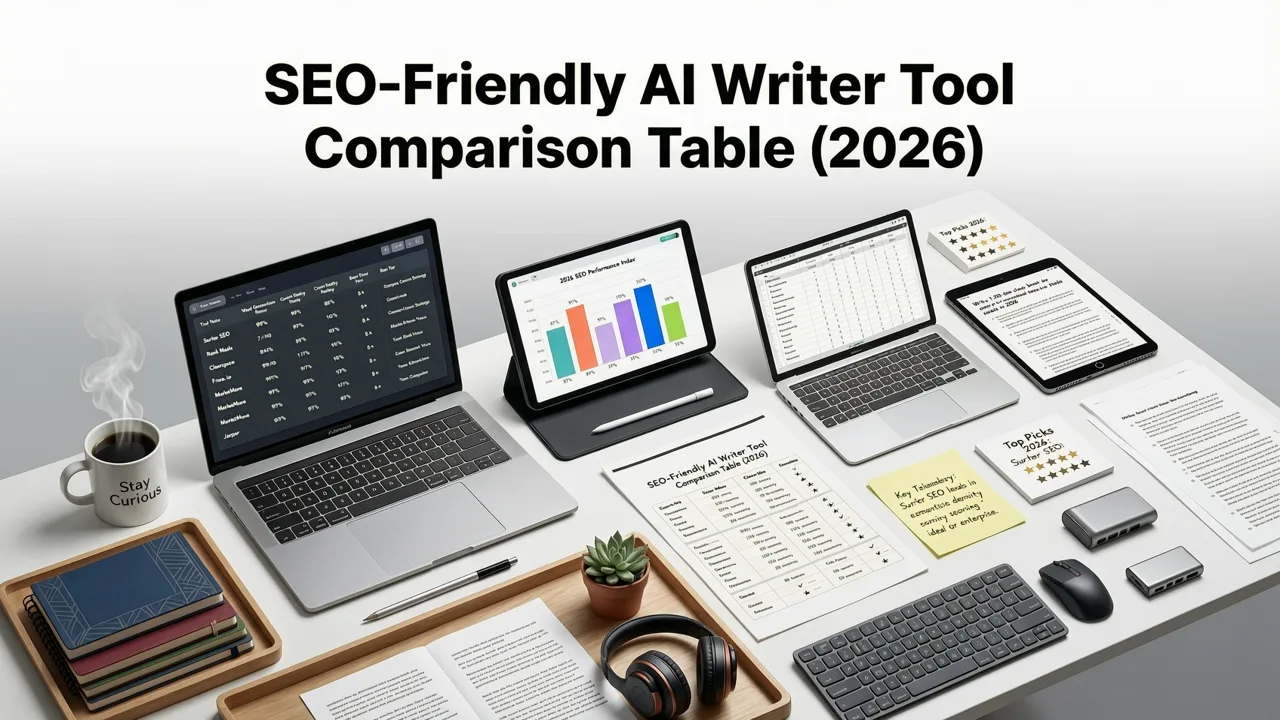
| Tool | Best For | Live SERP Analysis | Schema Output | Local SEO Features | Free Plan Available | Starting Price (2026) |
|---|---|---|---|---|---|---|
| MarketMuse Studio | Enterprise content strategy | Yes (real-time snapshot + intent graph) | FAQ, HowTo, Article, LocalBusiness | NAP sync, service-area schema, geo-headers | No | $599/month |
| Frase Enterprise | Agencies & content teams | Yes (SERP research and briefs) | FAQ, HowTo, Article | Location modifiers, service-area briefs | No (14-day trial) | $199/month |
| Surfer SEO AI Writer | Technical SEO practitioners | Yes (NLP-powered SERP parsing) | FAQ, HowTo, Article, Product | Geo-structured headings, local CTAs | No (7-day trial) | $89/month |
| Jasper | Brands & franchises | Limited (keyword-based clustering only) | FAQ, HowTo | Multi-location templates, NAP consistency | No (7-day trial) | $49/month |
| Copy.ai | Startups & early-stage SEO | Keyword + cluster-based (no live SERP) | FAQ (basic) | Geo-modified templates only | Yes (unlimited) | $36/month |
| Writesonic | Ecommerce & product SEO | Feed-driven (not SERP-scraped) | Product, Offer, Review, AggregateRating | Limited (geo-CTAs only) | Yes (10k chars/mo) | $24/month |
| Rytr | Solopreneurs & local SMBs | No | No native schema | Local-first templates, geo-headings | Yes (10k chars/mo) | $29/month |
What to Avoid When Choosing an SEO-Friendly AI Writer Tool
Not all AI writing tools are created equal—and many still operate on 2023-era assumptions about SEO. Here’s what to watch for in 2026:
- Overreliance on keyword density: Tools that still emphasize exact-match % targets (e.g., “use ‘best CRM software’ 3.2% of the time”) encourage keyword stuffing, which Google’s spam policies treat as spam.
- No E-E-A-T scaffolding: If the tool doesn’t prompt for author credentials, source citations, or firsthand experience statements, it’s not built for today’s helpful content standards.
- Zero local SEO awareness: For brick-and-mortar or service-area businesses, missing NAP consistency, service-area schema, or geo-modified headers is a critical gap—especially given Google’s increased scrutiny of local pack spam in Q2 2026.
- No schema validation or export: Generating FAQ or HowTo markup without validating against Schema.org’s 2026 spec risks rich result disapproval—or worse, manual actions for misleading structured data.
- Opaque AI training data: Avoid tools that won’t disclose whether their models were trained on licensed, authoritative content (e.g., medical journals, government publications) versus scraped web noise.
As noted in our deep-dive guide on what actually works in AI content generation for SEO, the strongest performers treat AI not as a replacement for human strategy—but as an amplifier of domain expertise, search intent insight, and technical precision.
How to Integrate Your SEO-Friendly AI Writer Tool Into Your Workflow
Adopting an AI writer isn’t about swapping editors for algorithms—it’s about redesigning your content production loop for quality, speed, and compliance. Here’s how to do it:
- Start with a validated brief: Use tools like Frase or MarketMuse to generate SERP-validated briefs—not keyword lists—before prompting the AI.
- Assign E-E-A-T roles: Designate who provides first-hand experience input (e.g., your HVAC technician reviewing the “furnace maintenance checklist”), who adds citations (e.g., linking to ENERGY STAR’s 2026 efficiency report), and who signs off on brand voice.
- Run AI output through technical SEO checks: Use Surfer or Screaming Frog to verify on-page elements (internal links, image alt attributes, heading hierarchy) before publishing.
- Validate schema before deployment: Paste generated JSON-LD into Google’s Rich Results Test (updated for 2026 schema extensions) and fix warnings—especially around datePublished, author, and reviewRating properties.
- Track performance by intent tier: Monitor rankings not just for primary keywords, but for supporting clusters (e.g., “cost to replace furnace” + “furnace installation timeline” + “best furnace brands 2026”) to measure true topical authority lift.
Final Thoughts: Choose Strategy Over Speed
An SEO-friendly AI writer tool in 2026 is less about how fast it writes—and more about how intelligently it collaborates with your SEO strategy, technical infrastructure, and brand authority. The tools that rise to the top don’t just generate text; they interpret SERPs, reinforce E-E-A-T, embed schema, and scale local relevance—without sacrificing human oversight.
If you’re evaluating options, start with your primary use case: enterprise strategy (MarketMuse), agency workflows (Frase), technical precision (Surfer), or local scalability (Jasper or Rytr). And remember: no tool replaces foundational SEO work—like local SEO for small business, solid keyword research, or authoritative link building. AI amplifies those efforts. It doesn’t replace them.


