

If you’re choosing keyword research tools in 2026, you’re not just comparing search volume metrics—you’re selecting an intelligence layer that interprets semantic clusters, predicts ranking volatility, maps user journey intent across touchpoints, and integrates with your AI content engine and technical SEO audit workflow. The best keyword research tools go beyond lists of search volumes: they group keywords by topic and intent and estimate how hard each one is to rank for.
Why the Best Keyword Research Tools in 2026 Are Fundamentally Different
In 2026, keyword research has moved from a one-off SEO task to an ongoing way of finding growth. Search volume alone tells you less than it used to, because results now depend on user context (e.g., location, device, recent searches), entity relationships, and behavioral signals—not just matching words.
This means keyword tools that rely solely on historical clickstream data or outdated CPC proxies are increasingly misaligned with actual organic opportunity. The best keyword research tools in 2026 instead combine:
- Live SERP analysis — tracking ranking volatility, featured snippet decay rates, and zero-click result saturation per query;
- Entity-aware clustering — grouping keywords by underlying topics, not just string similarity (leveraging Google’s Search Central documentation on entity-based indexing);
- Intent-layer mapping — distinguishing between navigational, commercial investigation, solution-comparison, and post-purchase support queries;
- First-party signal integration — pulling anonymized behavioral data from your GA4 property, CRM lead sources, and conversion paths to weight keyword relevance by business impact—not just traffic potential.
That’s why this guide compares keyword tools by how well they serve three kinds of sites: a B2B SaaS startup scaling content for mid-funnel awareness, an ecommerce brand optimizing product category pages for high-intent commercial queries, and a local service business refining hyperlocal keyword strategy for neighborhood-level visibility.
Top 6 Keyword Research Tools in 2026 (Free & Paid)
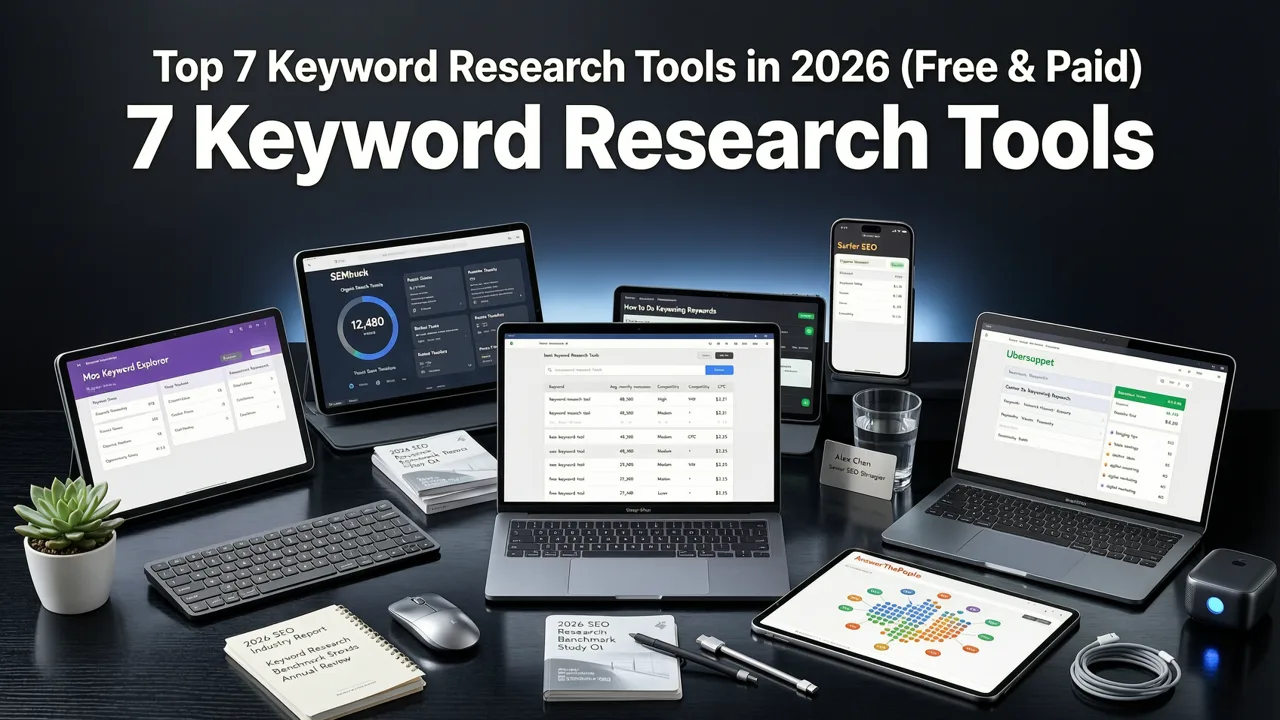
The criteria that matter most, roughly in order: SERP intent accuracy, keyword difficulty realism, AI-assisted clustering depth, API and workflow integrations, local and voice query coverage, and value for money as you scale.
1. Ahrefs Keyword Explorer (Paid — Industry Benchmark)
Ahrefs remains the most widely trusted platform for enterprise-grade keyword discovery—and its 2026 iteration delivers tangible upgrades. The new Intent Compass feature uses LLM-powered SERP classification to tag every keyword with primary and secondary intent labels (e.g., “commercial investigation → comparison → pricing”). Its updated Keyword Difficulty (KD) Score now factors in domain rating volatility, SERP feature dominance (e.g., how many top 10 results include FAQ schema or video carousels), and topical authority gaps—not just referring domains.
What sets it apart in 2026: Real-time Ranking Opportunity Alerts notify users when a competitor drops out of the top 3 for a high-value keyword—triggering automated content gap reports. Its integration with Google’s Schema.org validation suite helps identify markup opportunities tied directly to rising entity-based queries.
2. Semrush Keyword Magic Tool Pro (Paid — Best for Content Teams)
Semrush doubled down on collaborative workflow integration in 2026. The Keyword Magic Tool Pro now includes Content Brief Sync, which auto-generates briefs for writers—including semantic headers, entity recommendations, and ideal internal linking targets—based on top-ranking SERP features. Its Voice & Local Query Expansion module pulls from anonymized Google Assistant logs and GBP Insights data to surface “near me” and “how to” long-tail variants with measurable local search lift.
It also introduced Competitor SERP Overlap Heatmaps: visual overlays showing where your target keywords intersect with competitors’ actual rankings—not just their keyword lists. This is especially valuable for brands executing proven organic traffic growth tactics in competitive verticals.
3. Moz Pro Keyword Explorer (Paid — Most Transparent Scoring)
Moz continues to lead in methodological transparency. Its 2026 Keyword Difficulty score explicitly breaks down contributing factors: Domain Authority (DA), Page Authority (PA), backlink count, SERP feature competition, and on-page optimization strength of current top 10. No black-box algorithms—just auditable inputs. Its Priority Score ranks keywords not just by volume or difficulty, but by projected conversion likelihood, using historical CTR curves and landing page performance benchmarks.
Moz’s new Local Pack Integration ties keyword suggestions directly to GBP categories and review sentiment trends—making it a strong complement to local SEO strategy. Ideal for agencies managing multi-location clients.
4. Ubersuggest (Free Tier + Paid — Best Entry-Level Value)
Neil Patel’s Ubersuggest saw its most significant upgrade in 2026: full integration with Google Trends’ real-time regional interest data and YouTube Shorts search behavior. Its free tier now includes up to 50 keyword suggestions per seed term—with accurate monthly search volume, CPC, and Seasonal Volatility Index (SVI) for each. SVI measures how much a keyword’s volume spikes or dips quarterly—critical for inventory-led businesses and event-driven marketing.
For startups and solopreneurs building their first SEO foundation, Ubersuggest costs much less than enterprise suites. Check its current plans for the features you need.
5. AnswerThePublic (Free + Pro — Best for Question-Based & Voice Queries)
AnswerThePublic remains unmatched for uncovering natural-language, question-based, and voice-search intent. In 2026, it expanded its database to include over 2.1 billion real-world questions sourced from autocomplete, forum discussions (Reddit, Quora, niche communities), and voice assistant transcripts. Its new Question Cluster Map groups related queries by semantic proximity and shows which questions dominate early-funnel vs. late-funnel stages.
Pro users gain access to Question-to-Content Templates, which suggest blog structures, FAQ schema markup, and even ideal video script hooks based on dominant question phrasing. Especially powerful when paired with AI content generation workflows.
6. Keyword Surfer (Free Chrome Extension — Best for On-the-Fly Discovery)
Keyword Surfer shows keyword data directly in Google search results, so there’s no tab switching. Check its current features before relying on it for difficulty or click-through estimates.
Its biggest win: speed and zero friction. When auditing live SERPs during technical SEO audits or performing rapid content gap analysis, having real-time keyword metrics overlaid on actual results saves hours per week. It’s not a standalone platform—but an indispensable augmentation layer.
Comparison Table: Best Keyword Research Tools in 2026
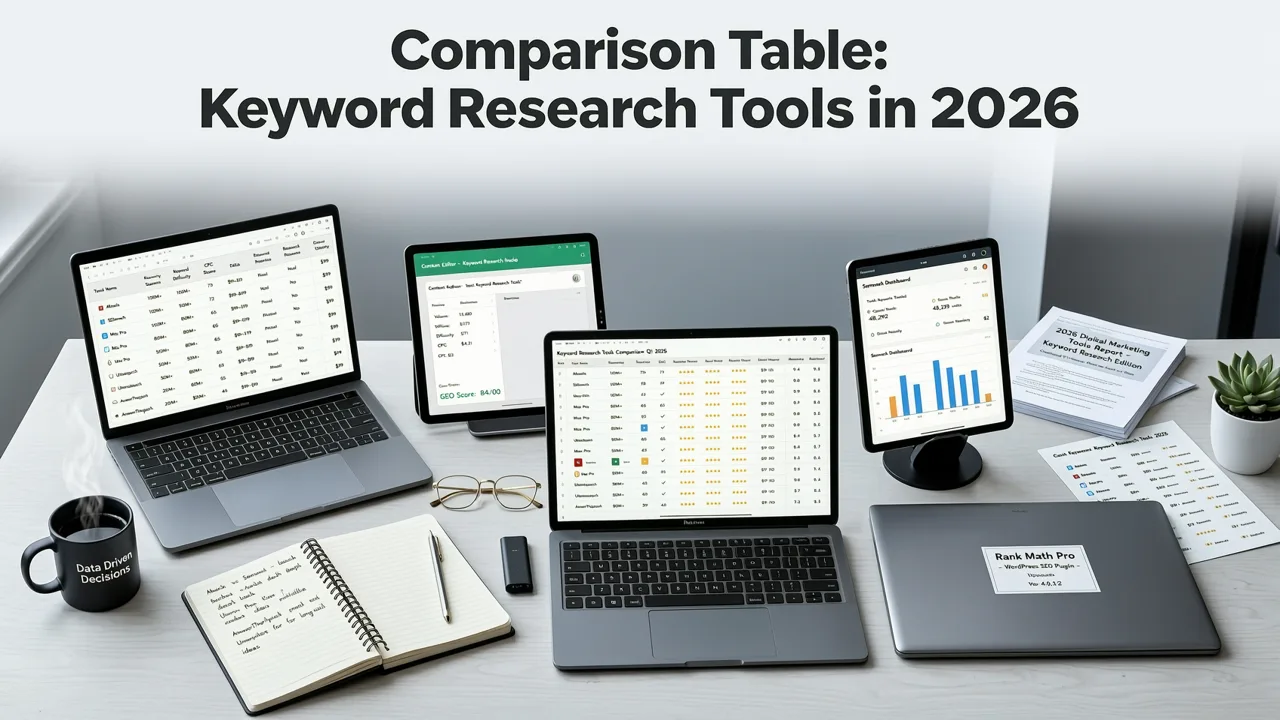
| Tool | Free Option? | Best For | Key 2026 Upgrade | Starting Price (2026) |
|---|---|---|---|---|
| Ahrefs Keyword Explorer | No (7-day trial) | Enterprise SEO, competitive analysis, technical + content alignment | Intent Compass + Ranking Opportunity Alerts | $129/mo |
| Semrush Keyword Magic Tool Pro | Yes (limited queries) | Content teams, cross-channel keyword planning, local + voice | Content Brief Sync + Competitor SERP Overlap Heatmaps | $149.95/mo |
| Moz Pro Keyword Explorer | No (30-day trial) | Transparency-focused teams, local SEO, DA/PA modeling | Priority Score + Local Pack Integration | $99/mo |
| Ubersuggest | Yes (full free tier) | Startups, solopreneurs, quick audits, seasonal planning | Seasonal Volatility Index + YouTube Shorts integration | $29/mo |
| AnswerThePublic | Yes (3 searches/day) | Blog ideation, FAQ schema, voice & question-based content | Question Cluster Map + Question-to-Content Templates | $119/year |
| Keyword Surfer | Yes (100% free) | Real-time SERP analysis, rapid discovery, technical audits | SERP-side difficulty + CTR estimation | Free |
How to Choose the Right Keyword Research Tool for Your Business in 2026
Don’t default to “what everyone else uses.” Your choice should align with your operational reality—not just feature lists. Here’s how to decide:
Choose Ahrefs if…
You manage multiple high-competition websites, need granular SERP feature forecasting, and require deep integration with technical SEO diagnostics. Ahrefs excels when your goal is to systematically identify keywords where technical fixes (e.g., Core Web Vitals, structured data, crawl budget allocation) can directly improve rankings.
Choose Semrush if…
Your team spans SEO, content, and PPC—and you need unified keyword intelligence across channels. Its cross-platform tagging, collaboration features, and local+voice expansion make it ideal for agencies and marketing departments prioritizing scalable, repeatable workflows.
Choose Moz if…
You prioritize explainability, compliance reporting, or work with regulated industries (legal, finance, healthcare) where audit trails matter. Moz’s transparent scoring model builds trust with stakeholders who need to understand *why* a keyword is ranked “high difficulty”—not just that it is.
Choose Ubersuggest or Keyword Surfer if…
You’re bootstrapping your first SEO initiative, validating a niche idea, or conducting rapid competitive reconnaissance. Their speed, simplicity, and zero-cost entry points lower the barrier to testing hypotheses—without committing to enterprise contracts.
Choose AnswerThePublic if…
You’re building FAQ schema, creating educational content, or optimizing for voice assistants and mobile-first search. Its question-centric architecture mirrors how users actually search—not how marketers assume they do.
What to Avoid in 2026: Outdated Keyword Research Practices
Even with the right tool, poor methodology undermines ROI. In 2026, these approaches are actively harmful:
- Chasing raw search volume alone — A keyword with 50K monthly searches but 92% zero-click SERPs delivers no traffic. Prioritize click-through opportunity over volume.
- Ignoring SERP feature saturation — If 8 of the top 10 results include video, shopping carousels, or AI-generated overviews, traditional text-based content won’t compete without strategic adaptation.
- Using static keyword difficulty scores — A KD score calculated in January 2026 may be obsolete by April if a major competitor launches a dedicated topic cluster or earns a viral backlink. Reassess monthly.
- Isolating keyword research from technical health — No tool can tell you whether your site’s crawl efficiency, canonicalization, or JavaScript rendering will prevent a well-targeted page from ranking—even if it’s perfectly optimized. Always pair keyword selection with your Technical SEO Audit Checklist.
Final Recommendation: Build a Layered Keyword Stack
The most effective 2026 keyword strategies don’t rely on one tool—they layer them:
- Discovery Layer (Free): Use Keyword Surfer + Ubersuggest for real-time, low-friction exploration during SERP audits.
- Validation Layer (Paid): Run high-potential keywords through Ahrefs or Semrush for intent alignment, difficulty realism, and competitor gap analysis.
- Content & Schema Layer (Specialized): Feed final keyword clusters into AnswerThePublic for question framing, then plan the structured data each page needs.
- Execution Layer (Integrated): Plug validated keywords into your AI content workflow, ensuring semantic richness, entity coverage, and natural language variation—not keyword stuffing.
This layered approach transforms keyword research from a one-time setup task into a continuous feedback loop—where each new piece of performance data refines the next round of targeting.
Conclusion & Next Steps
The best keyword research tools in 2026 aren’t defined by database size or flashy dashboards—they’re defined by how accurately they reflect *real user behavior*, *actual SERP dynamics*, and *your unique business goals*. Whether you’re launching your first SEO campaign or scaling enterprise organic growth, the right tool stack accelerates insight, reduces guesswork, and turns keyword strategy into a predictable growth channel.
If you’re ready to move beyond generic keyword lists and build a keyword intelligence system that drives qualified traffic, conversions, and long-term visibility—let’s build your 2026 keyword strategy together. We’ll conduct a free, no-obligation keyword opportunity assessment—including SERP feature analysis, intent mapping, and a prioritized roadmap aligned with your organic traffic growth goals.


