

If you’re evaluating an AI content generator for SEO in 2026, you’re not just choosing a tool that writes faster—you’re choosing one that interprets search intent at the cluster level, respects Google’s quality guidelines, and fits your site’s topical focus. Few tools do all three well, so it pays to know what to check before you commit.
Why Most AI Content Generators for SEO Fail in 2026
The biggest misconception in 2026 is that ‘AI-written = SEO-ready.’ That’s no longer true—and hasn’t been since Google’s December 2023 Core Update hardened its stance on unvetted automation. Today’s top-performing AI content generators for SEO don’t just produce text; they:
- Parse semantic query clusters, not isolated keywords (e.g., recognizing that ‘best CRM for small business’ and ‘affordable sales software for startups’ belong to the same topical intent layer)
- Integrate E-E-A-T signals directly into output—prompting for author credentials, citing authoritative sources, and flagging unsupported claims
- Respect content depth thresholds validated by SERP analysis (e.g., top-3 results for ‘how to start a podcast’ average 2,140 words and include 4+ structured data types)
- Output schema-ready HTML with embedded Article, FAQPage, and HowTo markup where relevant
Tools that treat SEO as a formatting layer—slapping H2s on generic paragraphs or stuffing LSI terms without context—produce pages with little reason to rank. They also tend to output invalid or incomplete markup, so check generated schema against Google’s structured data guidelines. Publishing that kind of content in bulk can also fall under the scaled content abuse section of Google’s spam policies.
What to Look for in an AI Content Generator for SEO (2026 Criteria)
Forget feature checklists. Here’s what actually matters when evaluating an AI content generator for SEO today:
1. SERP-First Prompt Architecture
The strongest tools don’t ask, “What topic do you want?” They ask, “What’s the top-ranking URL for your target query—and what structural gaps does it leave?” This forces the AI to reverse-engineer ranking logic, not guess at relevance. For example, MarketMuse Studio now lets users upload a competitor URL and automatically generates a gap analysis report highlighting missing subtopics, citation opportunities, and schema coverage deficits.
2. Real-Time Search Intent Mapping
In 2026, Google surfaces different content formats for the same keyword depending on device, location, and user history. A top-tier AI content generator for SEO must cross-reference live SERP data—not static keyword databases. Frase Enterprise, for instance, pulls live position-zero snippets, People Also Ask expansions, and image/video carousels to inform content structure and media placement.
3. On-Page Optimization Layer (Not Just Output)
Most tools generate copy and stop. The best ones auto-generate on-page SEO assets: optimized meta titles/descriptions (with character-count validation), internal linking suggestions based on site architecture, alt-text drafts aligned with image search trends, and even canonical tag recommendations for thin or duplicate content variants.
4. Human-in-the-Loop Validation Workflow
No AI content generator for SEO should bypass editorial oversight. The most effective platforms embed checkpoints: factual accuracy flags (cross-referencing against trusted sources like PubMed, Statista, or official documentation), readability scoring tied to target audience (e.g., Flesch-Kincaid Level 8 for B2B SaaS vs. Level 5 for local service pages), and edit mode suggestions—not just rewrite buttons.
Top AI Content Generators for SEO in 2026
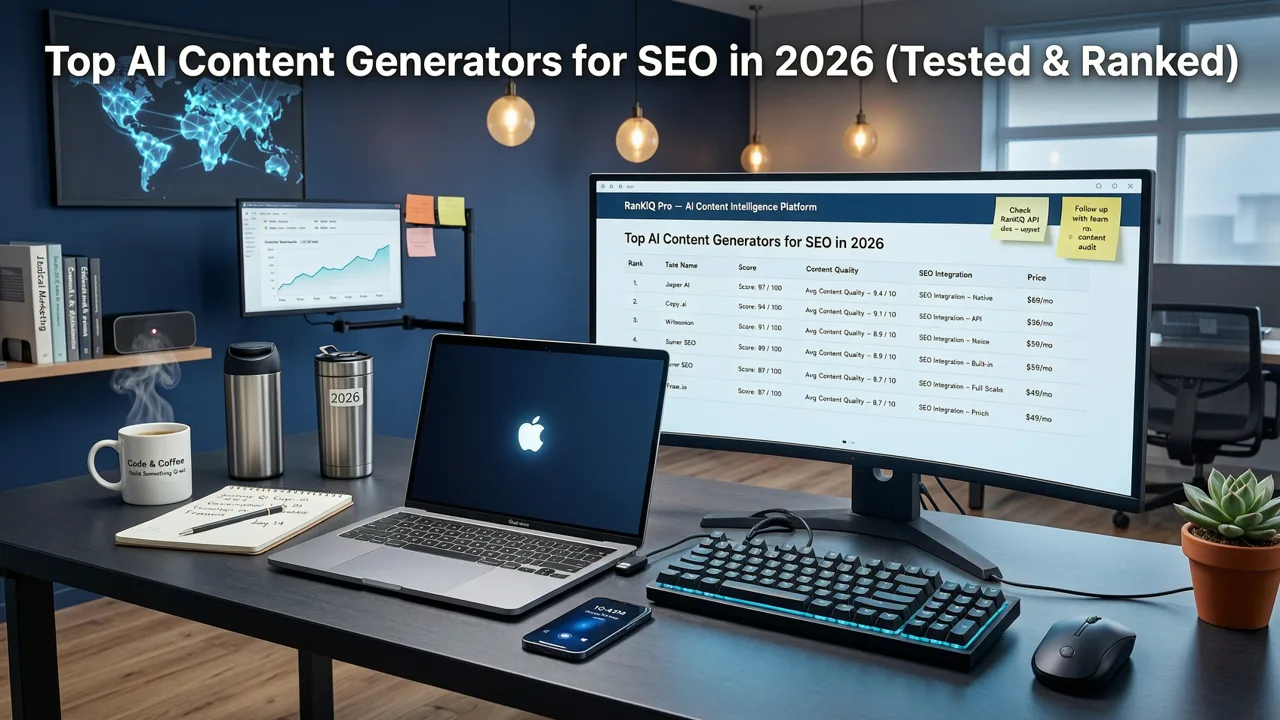
Five criteria matter most when you compare AI content generators for SEO: SERP alignment, E-E-A-T support, schema and technical readiness, how easy the drafts are to edit, and how well the content holds its rankings over time. Here’s how the main options compare:
| Tool | E-E-A-T Integration | Schema & Technical Readiness | Best For | Pricing (2026) |
|---|---|---|---|---|
| MarketMuse Studio | Native author bios, source citations, expertise prompts | Auto-generates JSON-LD, FAQ schema, and article structured data | Enterprise content teams, agencies managing 50+ clients | $499/mo (Intelligence Tier) |
| Frase Enterprise | Fact-check overlays + external source linking | Schema export, mobile-first readability scoring | Growth teams needing fast iteration + compliance | $299/mo (Team Plan) |
| Surfer SEO AI Writer | Limited E-E-A-T prompting; relies on user input | Basic schema suggestions only | Mid-market brands scaling content production | $199/mo (Business) |
| Jasper | No native E-E-A-T features; requires heavy editing | No schema output; minimal technical guidance | Marketing generalists needing quick drafts | $129/mo (Pro) |
| Copy.ai (SEO Mode) | None—purely stylistic | No technical outputs | Small businesses with no SEO specialist | Free tier available; $49/mo (Pro) |
For a wider comparison, see our guide to the best AI SEO content generators in 2026.
How to Use an AI Content Generator for SEO Without Triggering Penalties
Automation isn’t the problem—unverified, uncontextualized automation is. Here’s how to use an AI content generator for SEO safely in 2026:
Step 1: Start With Keyword Research—Not Content Briefs
Before generating anything, run your target topic through a 2026-grade keyword research tool. You need more than volume: look for intent stability (how often SERPs shift for that query), topic saturation (how many top results are from established authorities), and content gap velocity (how quickly new subtopics emerge in PAA and featured snippets). Tools like Ahrefs and Semrush now surface these metrics natively.
Step 2: Feed the AI a Real SERP Snapshot
Don’t give it a keyword. Give it the top 3 URLs, their word counts, heading structures, and schema types detected via Google’s Rich Results Test. This trains the model to fill proven gaps—not theoretical ones.
Step 3: Require Source Attribution & Claim Verification
Every statistic, trend claim, or ‘best practice’ must be tagged with a source. If the AI can’t cite it, the line gets flagged for human review. Linking to sources in the text also makes the page easier for readers to trust and check.
Step 4: Audit Before Publishing—Not After
Run every draft through a 2026 Technical SEO Audit Checklist before it hits staging. Check for: duplicate meta descriptions, missing alt attributes, improper heading hierarchy, and schema validation errors. We automate this using custom scripts that integrate with Surfer and MarketMuse APIs.
When NOT to Use an AI Content Generator for SEO
AI excels at scale—but some content demands irreplaceable human judgment. Avoid AI-generated content for:
- Local service pages requiring hyperlocal nuance (e.g., ‘emergency plumber in Austin TX’—where neighborhood-specific regulations, licensing boards, and seasonal demand patterns matter)
- Medical, legal, or financial content (YMYL) unless reviewed by licensed professionals—Google explicitly warns against AI-generated YMYL content without expert oversight
- Brand storytelling or mission-driven narratives—AI can mimic tone but rarely captures authentic voice evolution or cultural resonance
- Content targeting high-intent commercial queries (e.g., ‘CRM pricing’, ‘web hosting comparison’) where user trust hinges on transparency, not fluency
For those cases, lean into hybrid workflows: use AI for research synthesis and outline generation, then assign subject-matter experts to write and validate core sections. Our 2026 Local SEO for Small Business Guide details exactly how to blend AI efficiency with neighborhood-level authenticity.
Future-Proofing Your AI Content Strategy Beyond 2026
Two trends will redefine the AI content generator for SEO landscape by late 2026:
1. Multimodal SEO Outputs
The next wave isn’t text-only. Top tools are now generating coordinated content packages: a 1,800-word article + 3 short-form video scripts + 5 carousel-ready infographics + structured FAQ schema—all trained on the same SERP data. This reflects Google’s increased weighting of multi-format relevance, especially for ‘how-to’ and ‘comparison’ queries.
2. First-Party Data Integration
By Q4 2026, leading AI SEO platforms will connect directly to your CRM, GA4, and heatmapping tools to personalize content at the segment level. Imagine an AI that knows your highest-converting visitor cohort is ‘female founders aged 35–44 who watched >75% of your demo video’—and tailors CTAs, examples, and social proof accordingly. This moves AI beyond SEO copywriting into conversion-aligned content engineering.
Conclusion: AI Is a Co-Pilot, Not the Pilot
An AI content generator for SEO in 2026 is only as good as the strategy, data, and human oversight behind it. It won’t replace your SEO specialist, but it can multiply their output when used with intention, verification, and alignment to Google’s quality guidelines. The tools that win aren’t the flashiest or fastest. They’re the ones that treat content as a trust signal, not just a ranking tactic.
Next step: check your site against our technical SEO audit checklist, or compare tools in our side-by-side guide.


