

How do you optimize content for semantic search?
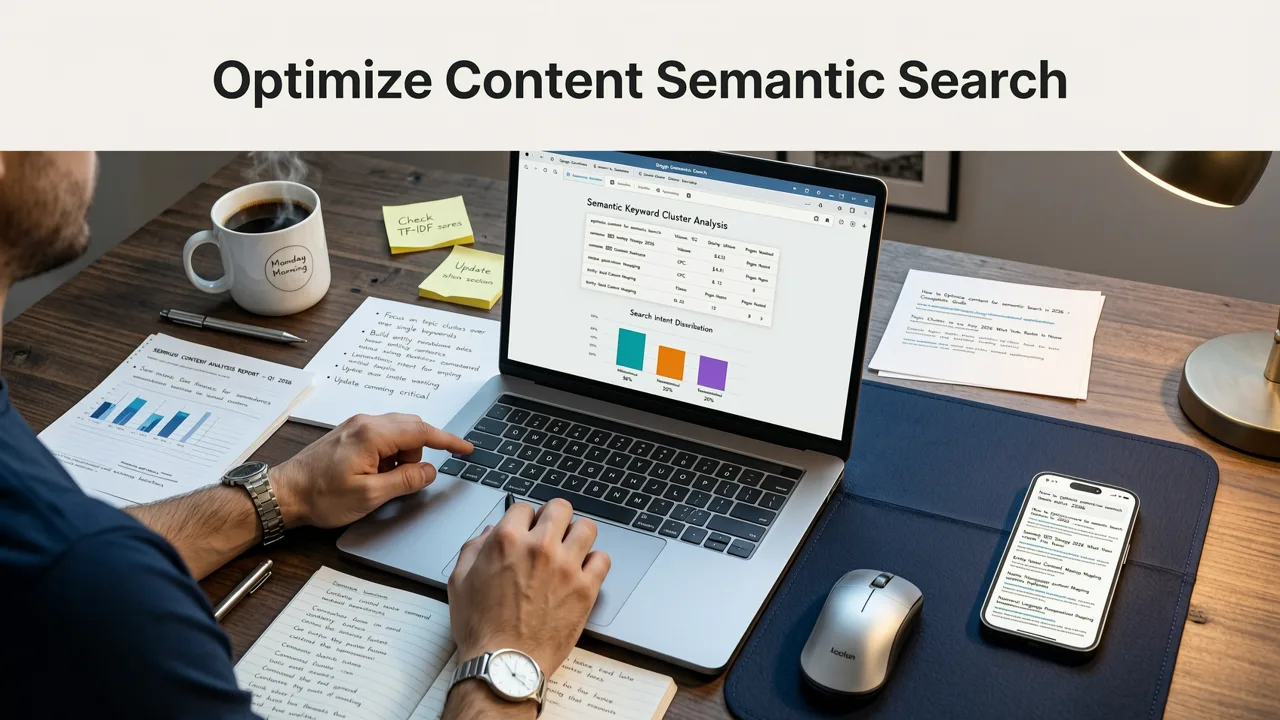
Write for the whole topic, not a single keyword. Answer the questions people ask about it, name the related concepts, products and people, link related pages into a topic cluster, use clear descriptive headings, and add structured data where it fits. Semantic search matches meaning and intent, so complete, well-organized coverage beats repeating a keyword.
In 2026, Google's AI Overviews, multimodal search, and entity-driven ranking systems reward content that demonstrates topical depth, clear information architecture, and structured data markup. This guide walks you through exactly how to build content that performs in both traditional search results and AI answer engines.
What Semantic Search Actually Means in 2026
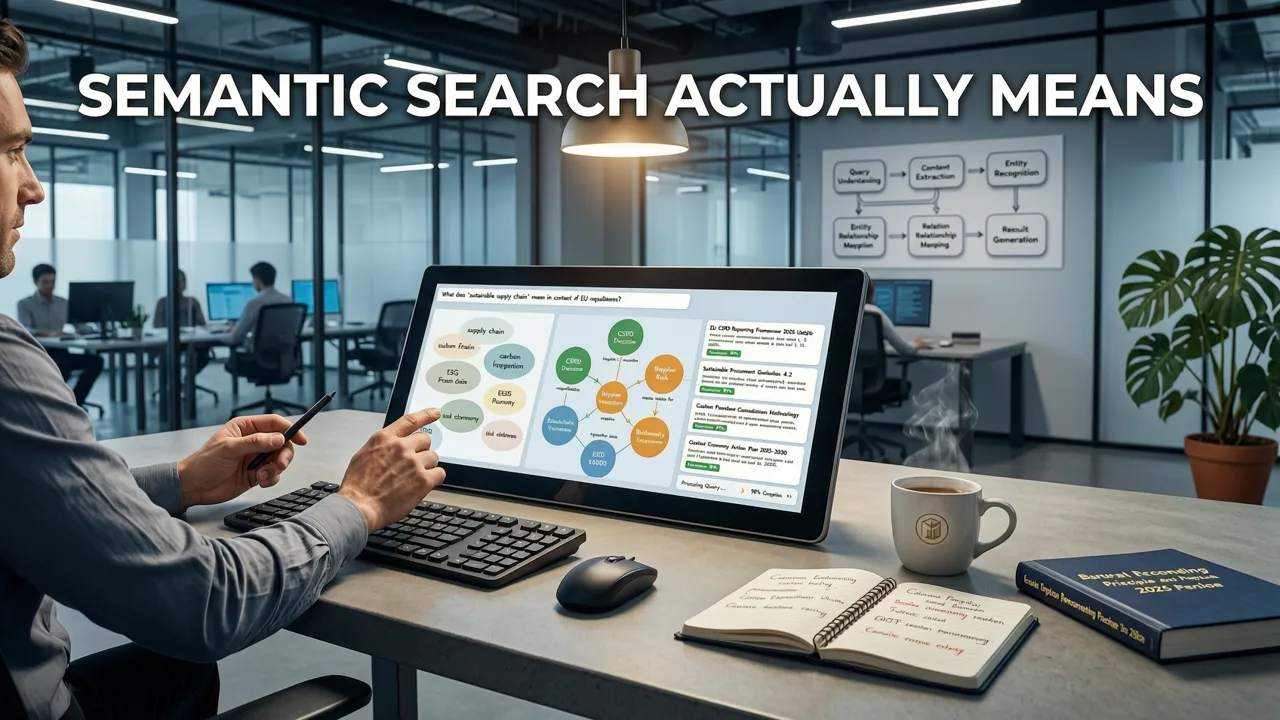
Semantic search is the process by which search engines interpret the meaning and intent behind a query rather than matching exact keyword strings. Google has been evolving toward semantic understanding since the Hummingbird update in 2013, but in 2026, the landscape looks fundamentally different.
Today's search engines operate on knowledge graphs that connect entities (people, places, things, concepts) with attributes and relationships. When you search "best CRM for ecommerce startups," the engine doesn't parse four separate keywords. It identifies that you're looking for a product category (CRM), filtered by use case (ecommerce), filtered by company stage (startups), and ranked by quality signals (best).
How Search Engines Understand Content
Google’s guide to its ranking systems names AI systems such as BERT, which helps it “understand how combinations of words express different meanings and intent”. In broad terms, this is what search engines do with a page:
- Entity recognition: The system identifies people, organizations, products, locations, and concepts mentioned in your content and cross-references them with its knowledge graph.
- Contextual understanding: Models evaluate how concepts relate to each other within your content, determining whether your article demonstrates genuine topical authority or shallow keyword repetition.
- Intent classification: The engine categorizes queries by intent (informational, navigational, commercial, transactional) and matches content that satisfies the full scope of that intent.
- Multimodal comprehension: Search engines now process text, images, video transcripts, and structured data together to build a unified understanding of a page.
For a deeper look at the technical side of how Google processes web content, the Google Search Central documentation remains the definitive reference for understanding crawler behavior and indexing signals.
Why Semantic Search Optimization Matters More Than Ever

The shift toward semantic search isn't a trend you can ignore. It's the foundation of how modern search engines operate. Here's why it should be central to your content strategy in 2026:
- AI Overviews dominate zero-click searches: Google's AI-generated summaries pull from content that clearly addresses user questions with structured, entity-rich information. If your content isn't semantically optimized, you won't be sourced.
- Keyword rankings are becoming less meaningful: A single page can rank for hundreds of semantically related queries. Tracking individual keyword positions misses the bigger picture of how your content performs across topic clusters.
- Voice and conversational search rely on semantic understanding: Natural language queries require content that matches conversational patterns and answers questions directly.
- Competitors are already optimizing: If your competitors structure their content with clear entities, relationships, and topical depth, their pages will outrank yours even if you have more backlinks.
Step 1: Build a Topic Cluster Architecture
Topic clusters are the backbone of semantic content optimization. Instead of creating isolated pages targeting individual keywords, you build a hub-and-spoke model where a pillar page covers a broad topic comprehensively, and cluster pages dive into specific subtopics.
How to Structure Your Topic Clusters
- Identify your core topic: Choose a broad subject area that your business has genuine authority in. For example, "local SEO" rather than "how to get more Google reviews."
- Map the semantic landscape: Use keyword research tools to identify all related queries, questions, and subtopics that fall under your core topic. Look for the entities, attributes, and relationships that connect these subtopics.
- Create a pillar page: Write a comprehensive overview (2,000–4,000 words) that covers the breadth of the topic without going too deep into any single subtopic. This page should naturally link to all cluster pages.
- Build cluster pages: Each cluster page targets a specific subtopic or long-tail query. These pages link back to the pillar page and to each other where contextually relevant.
- Establish internal linking patterns: Use descriptive anchor text that reflects the semantic relationship between pages. Avoid generic anchors like "click here."
If you're building out a content strategy from scratch or working with limited resources, our guide on the best SEO tools for startups covers platforms that help you map topic clusters and identify semantic gaps efficiently.
Step 2: Optimize for Entities, Not Just Keywords
Entities are the building blocks of semantic search. An entity is anything that search engines can identify as a distinct, unambiguous concept — a person, brand, product, location, event, or idea.
How to Make Your Content Entity-Rich
- Use specific, unambiguous language: Instead of writing "the company announced a new product," write "Shopify announced Shopify Magic, an AI-powered suite for ecommerce merchants." Specificity helps search engines disambiguate entities.
- Reference known entities in your niche: Mention industry leaders, established brands, recognized frameworks, and authoritative sources. This signals to search engines that your content exists within a recognized knowledge domain.
- Define entities clearly: When introducing a concept, provide a concise definition. For example: "Schema markup is a form of microdata that helps search engines understand the content on your web pages and generate rich snippets."
- Show relationships between entities: Explain how entities connect. "Semrush is a competitor to Ahrefs, but it offers a broader suite of marketing tools beyond SEO."
The Schema.org structured data reference provides the standardized vocabulary you can use to explicitly define entities and their relationships in your HTML.
Step 3: Implement Structured Data and Schema Markup
Structured data is the most direct way to communicate semantic meaning to search engines. In 2026, schema markup isn't optional if you want to compete for rich results, AI Overview citations, and knowledge panel appearances.
Essential Schema Types for Semantic Content
| Schema Type | Best Use Case | Semantic Signal |
|---|---|---|
| Article / BlogPosting | Blog posts, guides, news | Defines the content as a published piece with author, date, and topic |
| FAQPage | Question-and-answer content | Explicitly maps questions to answers for direct extraction |
| HowTo | Step-by-step guides | Structures procedural content with clear steps and outcomes |
| Product / Offer | Ecommerce and SaaS pages | Defines product attributes, pricing, availability, and reviews |
| Organization / Person | About pages, author bios | Establishes entity identity and E-E-A-T signals |
| BreadcrumbList | All pages | Reveals site hierarchy and content relationships |
| VideoObject | Video content pages | Provides metadata for video indexing and rich results |
How to Implement Schema Without Breaking Your Site
- Start with the schema types that match your most important pages. Blog posts should have Article schema. Service pages should have Service or Organization schema.
- Use JSON-LD format placed in the <head> of your pages. This is Google's recommended format and the least likely to cause rendering issues.
- Validate your markup using Google's Rich Results Test before publishing.
- Monitor your structured data performance in Google Search Console under the Enhancements section.
Step 4: Write for User Intent at Every Stage
Semantic search optimization requires matching the full spectrum of user intent, not just the informational intent behind a single query. Users searching for "how to optimize content for semantic search" might also need to understand what semantic search is, why it matters, and how to measure their progress.
Mapping Intent to Content Elements
- Informational intent: Provide clear definitions, explanations, and educational context. Answer "what," "why," and "how" questions directly.
- Commercial investigation intent: Include comparisons, pros and cons, and evaluation criteria. Help users decide between options.
- Transactional intent: Provide clear calls to action, pricing information, and next steps for users ready to take action.
- Navigational intent: Make sure your brand, product names, and key pages are clearly identifiable so search engines can connect users to the right destination.
A single piece of content can serve multiple intents. This article, for example, addresses informational intent (explaining semantic search), commercial intent (recommending tools and approaches), and transactional intent (guiding you toward implementation). Search engines reward content that satisfies the complete user journey.
Step 5: Use Natural Language and Conversational Patterns
Voice search and AI-driven conversational interfaces have accelerated the shift toward natural language queries. In 2026, a significant portion of searches are phrased as complete questions or conversational statements rather than truncated keyword strings.
Writing Techniques for Natural Language Optimization
- Answer questions directly: When you identify a common question in your niche, provide a concise answer in the first sentence of the relevant section. This makes it easier for AI systems to extract and surface your content.
- Use conversational headings: Instead of "Semantic Search Definition," try "What Is Semantic Search and Why Does It Matter?" This matches how users actually phrase queries.
- Incorporate related questions naturally: Address follow-up questions that users typically ask after the primary query. This demonstrates topical depth and captures long-tail traffic.
- Vary your sentence structure: Mix short, direct sentences with longer, explanatory ones. This mirrors natural speech patterns and improves readability.
Step 6: Build Topical Authority Through Content Depth
Topical authority is the degree to which search engines perceive your site as a comprehensive, trustworthy resource on a given subject. It's not about publishing more content — it's about publishing content that covers a topic with genuine depth and accuracy.
Signals That Build Topical Authority
- Comprehensive coverage: Your content addresses the full scope of a topic, including edge cases, common misconceptions, and advanced concepts.
- Consistent publishing: You regularly update and expand your content on a topic, signaling ongoing expertise.
- Internal linking coherence: Your topic clusters are tightly interconnected, making it easy for search engines to crawl and understand the breadth of your coverage.
- External validation: Other authoritative sites link to your content, cite your research, or reference your expertise.
- Author expertise signals: Clear author bios, credentials, and bylines that connect content to recognized experts.
Step 7: Measure Semantic Search Performance
Traditional keyword ranking reports don't capture the full picture of semantic search performance. You need to track how your content performs across topic clusters, how well it satisfies user intent, and whether it's being surfaced in AI-generated answers.
Key Metrics for Semantic SEO in 2026
- Topic cluster visibility: Track the aggregate rankings and traffic for all pages within a topic cluster, not just the pillar page.
- AI Overview appearances: Monitor how often your content is cited or referenced in Google's AI-generated summaries.
- Engagement metrics: Time on page, scroll depth, and return-to-SERP rates indicate whether your content satisfies user intent.
- Rich result impressions: Track how often your structured data generates rich snippets, FAQ dropdowns, and other enhanced listings.
For a detailed breakdown of how to track organic performance in the current analytics environment, our guide on how to track organic keyword performance in GA4 covers the workflows and custom explorations you need to build.
If you're noticing gaps in your organic search data, the article on Google Analytics organic search not showing troubleshoots the most common causes and fixes for 2026.
Semantic Search Optimization Checklist for 2026
| Action | Priority | Impact |
|---|---|---|
| Audit existing content for entity coverage and topical depth | High | Identifies gaps in semantic relevance |
| Build or refine topic cluster architecture | High | Establishes topical authority signals |
| Implement structured data on all key pages | High | Enables rich results and AI extraction |
| Rewrite thin or keyword-stuffed pages for semantic depth | Medium | Improves relevance and user satisfaction |
| Add FAQ and HowTo schema to applicable content | Medium | Increases rich result eligibility |
| Optimize internal linking with descriptive anchor text | Medium | Strengthens entity relationships |
| Monitor AI Overview citations and adjust content accordingly | Ongoing | Keeps content competitive in zero-click environments |
| Update and expand pillar pages quarterly | Ongoing | Maintains freshness and authority signals |
Common Mistakes That Undermine Semantic Optimization
Keyword Stuffing in the Name of "Relevance"
Repeating your target keyword dozens of times doesn't signal relevance — it signals spam. Search engines in 2026 penalize content that prioritizes keyword density over natural, useful communication. Write for humans first, and the semantic signals will follow.
Ignoring Content Relationships
Publishing a great article on "technical SEO" and another on "site speed optimization" without linking them together wastes the semantic relationship between those topics. Internal linking isn't just for crawlability — it's how you teach search engines how your content connects.
Treating Structured Data as an Afterthought
Adding schema markup after publishing is better than never adding it, but it's more effective to plan your structured data strategy before you write. Decide which schema types your page needs, then write content that naturally supports those entities and attributes.
Neglecting Content Freshness
Semantic search rewards content that reflects current information. An article about "best SEO practices" written in 2023 and never updated will lose semantic relevance as the landscape evolves. Schedule regular content reviews to ensure your pages stay current.
The Future of Semantic Content Optimization
Semantic search isn't a destination — it's a direction. As AI models become more sophisticated, the gap between content that's optimized for search engines and content that's genuinely useful to humans will continue to narrow. The best optimization strategy in 2026 and beyond is to create content that demonstrates real expertise, covers topics comprehensively, and communicates clearly.
Search engines are getting better at identifying content that's written primarily to manipulate rankings. They're also getting better at rewarding content that serves users well. The companies that win in organic search will be the ones that treat semantic optimization as a byproduct of genuinely helpful content, not as a technical trick to game the system.
For teams looking to build a comprehensive reporting framework around their semantic SEO efforts, the best GA4 reports for SEO guide covers the dashboards and explorations that align with modern search performance measurement.
Final Thoughts
Learning how to optimize content for semantic search in 2026 means embracing a fundamental shift in how you think about SEO. It's no longer about matching keywords to queries. It's about building a body of content that search engines can understand at a conceptual level — content that demonstrates expertise, covers topics thoroughly, and communicates in the natural language your audience uses.
Start by auditing your existing content for entity coverage and topical depth. Build topic clusters around your core subjects. Implement structured data. Write for humans, and let the semantic signals follow. The search engines of 2026 reward substance over tactics, and the teams that understand this will dominate organic visibility for years to come.
If you're ready to build a semantic content strategy that drives measurable organic growth, start with the checklist above and track your progress using the measurement frameworks outlined in this guide. The foundations you build today will compound into lasting search visibility.


