

Why the Best AI Content Optimization Tool in 2026 Is About Strategy, Not Just Suggestions
If you are evaluating the best AI content optimization tool in 2026, you already know the landscape has shifted. Generic keyword-density checkers and surface-level readability scores no longer move rankings. Today, search engines reward content that demonstrates topical depth, structural clarity, and verifiable expertise. The right AI content optimization tool does more than rewrite a sentence — it aligns your pages with how modern algorithms actually interpret intent, entities, and trust.
This guide breaks down what separates a real optimization engine from a glorified thesaurus. We compare the leading platforms, map their feature sets to real SEO outcomes, and show you how to choose the one that fits your team, your stack, and your growth goals. Whether you run a startup, an ecommerce brand, or a marketing agency, you will walk away with a clear shortlist and a framework for using these tools without sacrificing authenticity.
What Makes an AI Content Optimization Tool Actually Effective in 2026?
Not every tool that brands itself as AI-powered deserves the label. In 2026, an effective AI content optimization tool must operate across three layers: semantic intelligence, technical compliance, and workflow integration. If a platform only handles one layer, it becomes a bottleneck rather than a multiplier.
1. Semantic and Intent-Aware NLP Scoring
Modern search engines parse content through natural language models that understand entities, relationships, and user intent. A strong optimization tool mirrors this behavior. It analyzes top-ranking pages, extracts the underlying topic graph, and tells you which concepts, questions, and supporting entities your draft is missing. This goes far beyond keyword frequency — it is about coverage, coherence, and contextual relevance.
2. Real-Time Schema and Structured Data Compliance
Structured data is no longer optional for competitive niches. The best tools validate schema markup inline as you write, flag missing properties, and suggest the correct schema.org types for your content format. This prevents the common gap between publishing and rich-result eligibility.
3. SERP-Driven Brief Generation
An optimization tool that ignores live SERP data is flying blind. In 2026, the leading platforms pull real-time results — including featured snippets, People Also Ask clusters, and video carousels — to generate content briefs that reflect what the algorithm currently rewards for a given query.
4. Workflow Integration and Collaboration
Content teams do not work in isolation. The best platforms connect to Google Docs, WordPress, Notion, and headless CMS environments. They track optimization progress across drafts, assign tasks, and log revision history so editors and writers stay aligned.
Top AI Content Optimization Tools in 2026
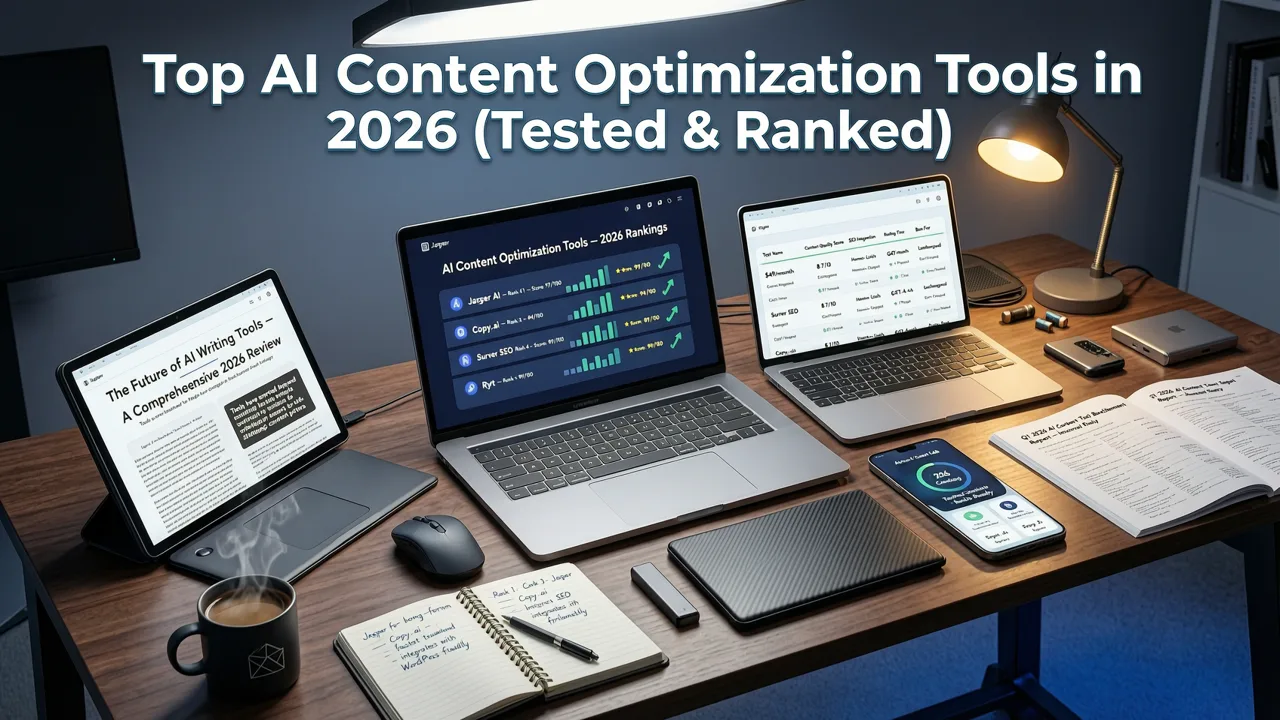
Each tool below is compared on semantic depth, technical accuracy, ease of use, and integration breadth.
1. MarketMuse — Best for Enterprise Content Intelligence
MarketMuse remains the benchmark for large content teams that need a unified optimization and planning engine. Its Topic Explorer maps your entire site against the competitive landscape, identifies content gaps, and prioritizes briefs by projected traffic impact. The NLP scoring engine is among the most granular available, and its automated internal linking suggestions reduce manual overhead significantly.
Best for: Agencies and enterprise brands managing hundreds of pages per month.
2. Surfer SEO — Best for On-Page Precision
Surfer SEO continues to excel at real-time on-page analysis. Its Content Editor scores your draft against live SERP averages for word count, heading structure, NLP term density, and image placement. For teams that want a fast, visual optimization loop, Surfer is hard to beat.
Best for: SEO specialists and in-house teams focused on on-page execution.
3. Frase — Best for Research-to-Publish Workflows
Frase combines SERP research, outline generation, and optimization in a single interface. Its AI writer integrates directly into the brief, allowing you to draft, refine, and score without switching tabs. Frase also excels at aggregating People Also Ask data and converting it into structured FAQ sections that align with Google Search Central documentation best practices.
Best for: Small teams and solo marketers who need an end-to-end workflow.
4. Clearscope — Best for Content Quality Benchmarking
Clearscope is known for its rigorous content grading system. It compares your draft against the top-ranking pages and assigns a letter grade based on term usage, readability, and topical coverage.
Best for: Brands that prioritize editorial quality and E-E-A-T signals.
5. NeuronWriter — Best Budget-Friendly NLP Optimization
NeuronWriter delivers surprisingly deep NLP analysis at a fraction of the cost of enterprise tools. It uses Google's own NLP API to score your content and suggests semantically related terms, questions, and entities. While it lacks the workflow features of larger platforms, it is an excellent choice for startups and freelancers who need solid optimization without the overhead.
Best for: Startups, freelancers, and lean marketing teams.
Feature Comparison: AI Content Optimization Tools in 2026
The table below summarizes the core capabilities of each platform so you can compare them side by side.
| Tool | NLP Scoring | SERP Live Data | Schema Validation | CMS Integration | Best For |
|---|---|---|---|---|---|
| MarketMuse | Advanced | Yes | Yes | WordPress, Docs | Enterprise teams |
| Surfer SEO | Advanced | Yes | Yes (2026) | Docs, WordPress | On-page SEO specialists |
| Frase | Strong | Yes | Partial | Docs, WordPress | Small teams & solo marketers |
| Clearscope | Advanced | Yes | Partial | Docs, WordPress | Editorial quality focus |
| NeuronWriter | Strong | Yes | No | Limited | Startups & freelancers |
How to Choose the Right AI Content Optimization Tool for Your Business
Selecting the right platform depends on your team size, content volume, and technical maturity. Use the following decision framework to narrow your options.
Step 1: Define Your Primary Bottleneck
Are you struggling with research and brief creation, or with on-page execution after the draft is written? If research is the bottleneck, prioritize tools like Frase or MarketMuse. If on-page refinement is the issue, Surfer SEO or Clearscope will serve you better.
Step 2: Audit Your Existing Stack
Check whether the tool integrates with your CMS, project management platform, and analytics dashboard. A powerful optimization tool that requires constant context-switching will see low adoption across your team. If you are building out your broader toolkit, you may also want to explore the best SEO tools for startups to ensure your foundation is solid.
Step 3: Evaluate Semantic Depth
Run a test draft through each platform's free trial. Compare the NLP suggestions against your own expertise. If the tool recommends irrelevant terms or misses obvious entities, it is not ready for prime time.
Step 4: Measure Impact Over 90 Days
Track rankings, organic traffic, and engagement metrics for pages optimized with the tool. The right platform should produce measurable lift within one to two indexing cycles. If it does not, reassess your workflow before switching tools.
Common Mistakes When Using an AI Content Optimization Tool
Even the best platform will underperform if your workflow is flawed. Avoid these pitfalls to get the most from your investment.
- Chasing the score instead of the reader. A perfect NLP grade means nothing if the content feels robotic. Always prioritize clarity and usefulness over algorithmic gaming.
- Ignoring search intent. Optimization tools analyze top-ranking pages, but those pages may not reflect the intent you are targeting. Verify intent manually before trusting the brief.
- Skipping schema validation. Many teams optimize text but forget structured data. Use a dedicated AI tool for on-page SEO to catch schema errors before publish.
- Publishing without editorial review. AI suggestions are a starting point, not a final draft. Human editing remains essential for tone, accuracy, and brand voice.
- Over-optimizing a single page. Stuffing every recommended term can dilute topical focus. Aim for comprehensive coverage, not keyword saturation.
How AI Content Optimization Fits Into a Broader SEO Strategy
An AI content optimization tool is a powerful component of your SEO engine, but it does not operate in isolation. In 2026, sustainable organic growth requires alignment across technical SEO, content strategy, link acquisition, and local visibility.
For businesses with a physical presence or service-area focus, combining content optimization with a strong local strategy is essential. Our local SEO strategy guide outlines how to layer structured data, review management, and hyperlocal content for maximum impact.
If your team is also generating large volumes of content, pairing your optimization tool with a capable AI SEO content generator can accelerate your pipeline while maintaining quality. The key is to treat generation and optimization as two distinct phases, each with its own quality checkpoints.
The ROI of Using an AI Content Optimization Tool in 2026
When used correctly, these tools reduce the time required to produce ranking-ready content by a significant margin. They also lower the risk of publishing thin or misaligned pages that drain crawl budget and dilute topical authority. The return on investment shows up in three ways:
- Faster time to rank. Pages optimized with semantic depth and schema compliance tend to reach page one more quickly than those published without structured guidance.
- Higher content efficiency. Teams publish fewer pages that perform better, reducing wasted effort on low-impact topics.
- Stronger topical authority. Consistent optimization across a topic cluster signals expertise to search engines, compounding rankings over time.
Final Thoughts: Picking the Right Tool for Your Team
The best AI content optimization tool in 2026 is the one that fits your team's workflow, respects your editorial standards, and delivers measurable results. Whether you choose MarketMuse for enterprise intelligence, Surfer SEO for on-page precision, or Frase for end-to-end simplicity, the critical factor is how you use it. Treat these platforms as strategic advisors, not autopilot buttons, and your content will reflect the depth and trust that modern search demands.


