

The 2026 Content Optimization Checklist for SEO
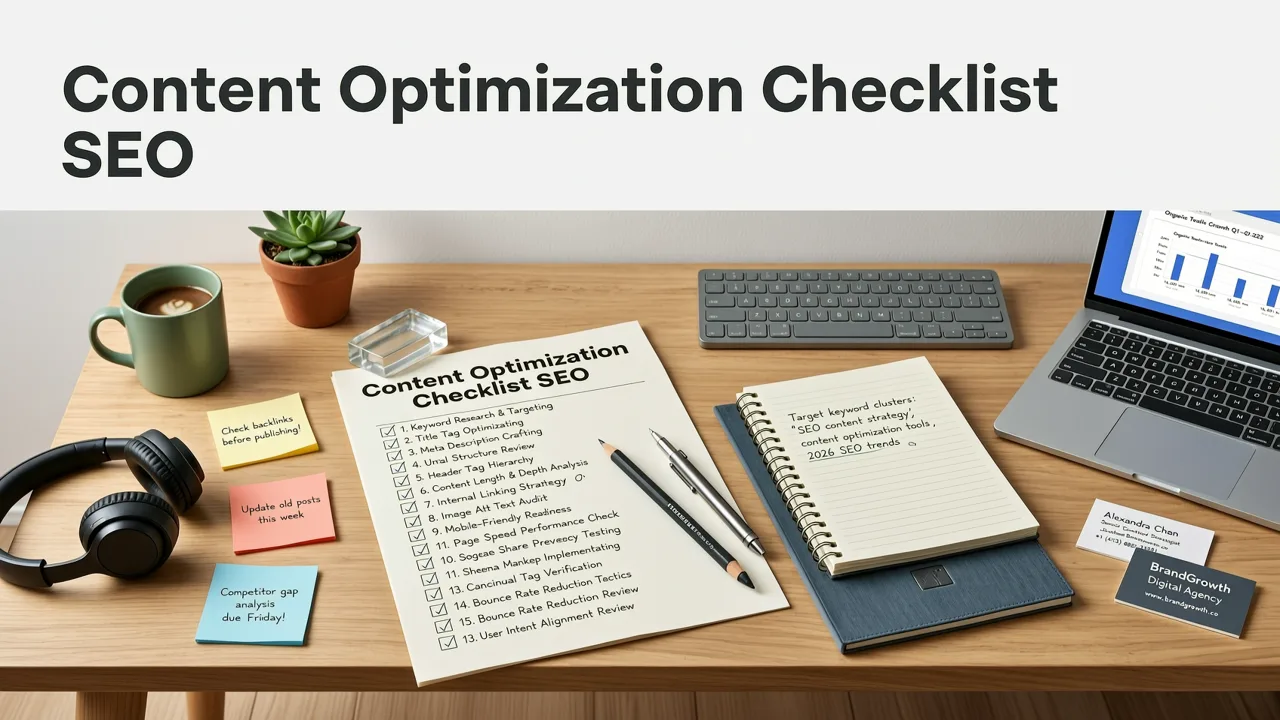
If you publish content without a disciplined optimization process, you are leaving rankings, traffic, and revenue on the table. This content optimization checklist for SEO gives you a repeatable, priority-ranked workflow that covers keyword alignment, on-page signals, E-E-A-T, schema, and AI-overview readiness.
Bookmark this guide, run it against every new draft, and revisit it quarterly on existing content. By the end of this article you will have a complete, actionable checklist that works whether you publish ten pages a month or ten thousand.
Why a Content Optimization Checklist Matters More in 2026

Google says its ranking systems are designed to prioritize “helpful, reliable information that’s created to benefit people”. AI Overviews, multimodal search, and conversational query formats have changed what "optimized" means. A page that ranks today must satisfy both traditional crawlers and AI answer engines.
A structured content optimization checklist for SEO prevents three common failures:
- Keyword drift — writing around a topic instead of a clearly defined search intent.
- On-page neglect — strong content that never ranks because title tags, headings, and schema are incomplete.
- E-E-A-T gaps — content that lacks author identity, sourcing, or freshness signals Google now weighs heavily.
Fixing these issues systematically is what separates pages that earn sustained organic growth from those that plateau after publication.
Phase 1: Keyword & Intent Research
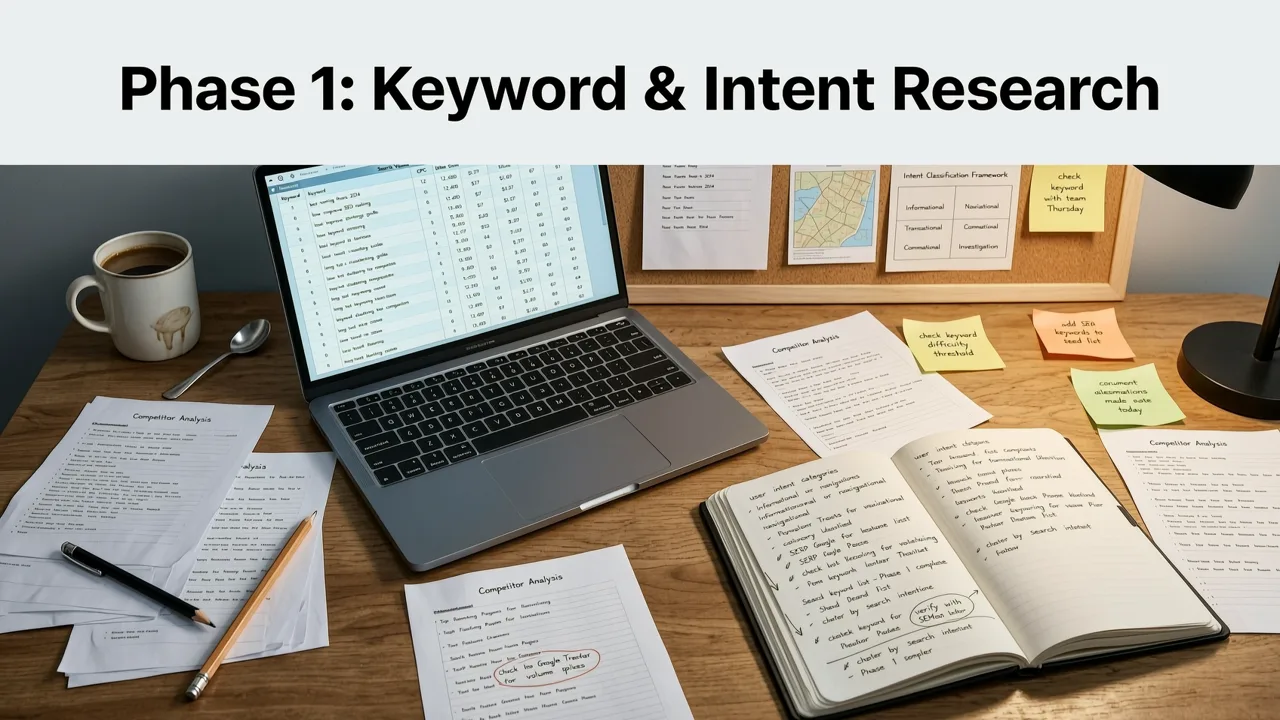
Optimization begins before a single word is written. The goal is to confirm that the target keyword maps to a specific, defensible search intent and that supporting entities are identified.
1.1 Define the Primary Keyword and Search Intent
Write the primary keyword, the search intent (informational, commercial, transactional, navigational), and the stage of the buyer journey. If the intent is unclear, check the current SERP — Google's top results reveal what the algorithm believes users want.
1.2 Map Supporting Keywords and Semantic Entities
Identify 8 to 15 semantically related terms, questions, and entities. These become the subtopics that give your content topical depth. Tools that analyze schema.org entity relationships and knowledge graph connections can surface entities you might otherwise miss.
1.3 Audit Existing Content for Cannibalization
Before publishing, search your own site for the primary keyword and close variants. If multiple pages compete, consolidate or differentiate them. Cannibalization is one of the most common reasons well-written content fails to rank.
Phase 2: Content Structure & Outline
A strong outline is the skeleton of ranking content. It determines how thoroughly you cover the topic and how clearly search engines can parse your page.
2.1 Build a Heading Hierarchy That Mirrors User Questions
Use H2s for major sections and H3s for subtopics. Each heading should answer a question or address a sub-intent a user might have. Avoid decorative headings that add no semantic value.
2.2 Include a Direct Answer Up Front
Google's AI Overviews and featured snippets favor pages that deliver a concise answer within the first 100 to 150 words. State the core answer clearly, then expand with detail. This is non-negotiable for informational queries in 2026.
2.3 Plan for Scannability
Short paragraphs, bulleted lists, numbered steps, and pull quotes all reduce cognitive load. Mobile-first indexing means most readers will encounter your content on a small screen — design for that reality.
Phase 3: On-Page SEO Optimization
This is the core of the content optimization checklist for SEO. Every item below is a ranking factor or a strong correlation signal documented across industry testing.
3.1 Title Tag Optimization
Keep the title under 60 characters, place the primary keyword near the front, and include a differentiating angle (year, format, or audience). Avoid generic titles that could describe any page on your site.
3.2 Meta Description
Write a meta description between 130 and 165 characters that includes the keyword and a clear value proposition. Treat it as ad copy — it influences click-through rate, which indirectly affects rankings.
3.3 URL Structure
Use a short, readable URL that contains the primary keyword. Avoid dynamic parameters, session IDs, or unnecessary folder depth.
3.4 Heading Tags and Keyword Placement
Include the primary keyword in the H1 and at least one H2. Use supporting keywords naturally in H3s. Never force keywords into headings where they disrupt readability.
3.5 First 100 Words
The opening paragraph should contain the primary keyword, answer the searcher's question, and preview what the page covers. This section is weighted heavily by both crawlers and AI summarization systems.
3.6 Internal Linking
Link to 3 to 7 relevant internal pages using descriptive anchor text. Internal links distribute equity, reinforce topical clusters, and help crawlers discover your most important content. If you are building a broader organic strategy, our guide on how to increase organic search traffic in 2026 covers cluster architecture in depth.
3.7 Image Optimization
Compress images, use modern formats like WebP or AVIF, and write descriptive alt text that includes relevant keywords where natural. Add structured captions when they add context.
Phase 4: E-E-A-T and Content Quality Signals
Experience, Expertise, Authoritativeness, and Trust are not optional in 2026. Google's quality rater guidelines ask raters to look for first-hand experience, and its ranking systems aim to reward helpful content.
4.1 Author Bylines and Bios
Every piece of content should have a named author with a detailed bio, credentials, and links to other published work. Anonymous content is a ranking liability in competitive niches.
4.2 Citations and Source Linking
Link to authoritative external sources when you reference data, research, or expert opinions. Citing Google Search Central documentation for technical claims, for example, strengthens trust signals.
4.3 Freshness and Review Dates
Display both the original publish date and the last updated date. Review and update high-value pages at least once per quarter. Stale content loses rankings to fresher competitors.
4.4 Original Data and Unique Perspectives
Include proprietary insights, case studies, screenshots, or original analysis. Content that simply restates what already exists on page one of Google has no reason to rank.
Phase 5: Technical and Schema Optimization
Technical signals tell search engines what your content is and how to display it. Skipping this phase is one of the most common optimization failures.
5.1 Structured Data Markup
Add relevant schema types: Article, FAQPage, HowTo, Product, Review, or BreadcrumbList as appropriate. Validate markup using Google's Rich Results Test. Proper schema increases your chances of earning rich snippets and AI Overview citations.
5.2 Core Web Vitals
Ensure the page passes LCP, INP, and CLS thresholds. A technically perfect content piece will underperform if it loads slowly or shifts layout during rendering. Run a technical SEO audit to catch performance issues before they compound.
5.3 Mobile Usability
Test the page on real mobile devices. Check tap targets, font sizes, horizontal scrolling, and interstitial behavior. Mobile usability remains a confirmed ranking factor.
5.4 Crawlability and Indexing
Confirm the page is not blocked by robots.txt, has a self-referencing canonical tag, and is included in your XML sitemap. Check Google Search Console for indexing status after publication.
Phase 6: AI Overview and Answer Engine Readiness
In 2026, a significant share of organic clicks come from AI-generated answers. Optimizing for these systems requires a slightly different approach than traditional SEO.
6.1 Write in Declarative, Quotable Sentences
AI answer engines pull direct statements. Use clear, factual sentences that can be extracted as standalone answers. Avoid overly complex clauses and vague qualifiers.
6.2 Structure Content for Extraction
Use definition-style paragraphs, numbered steps, and comparison tables. These formats are easier for AI systems to parse and cite. The table below is an example of an extraction-friendly format.
6.3 Provide Contextual Depth
AI Overviews favor content that covers a topic comprehensively. A page that answers the primary query and five related sub-queries will outperform a page that only addresses the surface question.
The Complete 2026 Content Optimization Checklist
Use this table as a quick-reference before publishing any page. Each item is prioritized by impact.
| Priority | Checklist Item | Phase |
|---|---|---|
| High | Primary keyword matches confirmed search intent | 1 — Research |
| High | Direct answer in the first 100–150 words | 2 — Structure |
| High | Title tag under 60 characters with keyword near the front | 3 — On-Page |
| High | Meta description 130–165 characters with keyword and value prop | 3 — On-Page |
| High | Keyword in H1 and at least one H2 | 3 — On-Page |
| High | Named author with credentials and bio | 4 — E-E-A-T |
| High | Core Web Vitals passing on mobile and desktop | 5 — Technical |
| Medium | 8–15 semantic keywords and entities covered | 1 — Research |
| Medium | 3–7 internal links with descriptive anchor text | 3 — On-Page |
| Medium | Authoritative external citations included | 4 — E-E-A-T |
| Medium | Relevant schema markup validated | 5 — Technical |
| Medium | Images compressed with descriptive alt text | 3 — On-Page |
| Medium | Publish and last-updated dates displayed | 4 — E-E-A-T |
| Low | No cannibalization with existing pages | 1 — Research |
| Low | Clean URL with keyword, no unnecessary parameters | 3 — On-Page |
| Low | Page included in XML sitemap and not blocked by robots.txt | 5 — Technical |
Phase 7: Post-Publication Optimization
Optimization does not end at publish. The highest-performing pages are refined continuously based on real performance data.
7.1 Monitor Rankings and Click-Through Rate
Track the page in Google Search Console for impressions, clicks, CTR, and average position. If impressions are high but CTR is low, rewrite the title tag and meta description.
7.2 Update Based on SERP Changes
Revisit the SERP every 60 to 90 days. If new subtopics appear in related searches or AI Overviews, add sections to your page to cover them.
7.3 Refresh with New Data and Examples
Add current-year examples, updated statistics, and new internal links as your site grows. A page that is refreshed regularly signals ongoing relevance to both crawlers and users.
7.4 Build Targeted Backlinks
Promote the page through outreach, digital PR, and content partnerships. High-quality backlinks remain one of the strongest ranking differentiators for competitive keywords.
Common Content Optimization Mistakes to Avoid in 2026
Even experienced marketers fall into these traps. Watch for them during your review process:
- Keyword stuffing in headings — modern algorithms detect forced keyword placement and downgrade it.
- Thin content disguised as long-form — word count alone does not equal quality. Every section must add unique value.
- Ignoring search intent — a transactional query will not rank with an informational page, no matter how well optimized.
- Skipping schema — structured data is a low-effort, high-reward optimization that many teams still neglect.
- Publishing and forgetting — content that is never updated loses rankings to fresher competitors within months.
Using AI Tools in Your Optimization Workflow
AI-powered tools can accelerate keyword research, entity mapping, and content drafting — but they cannot replace strategic judgment. The best results come from combining AI efficiency with human editorial oversight. If you are evaluating tools to speed up your workflow, our comparison of the best AI SEO content generators in 2026 tests the leading platforms on real-world output quality and SEO performance.
Whichever tools you choose, use this content optimization checklist for SEO as the final quality gate. Tools generate the draft; the checklist ensures the draft is ready to rank.
Conclusion: Make This Checklist Part of Your Publishing Process
Ranking in 2026 requires more than good writing. It requires a disciplined, repeatable optimization process that covers research, structure, on-page signals, E-E-A-T, technical health, and AI readiness. This content optimization checklist for SEO gives you that process in a single, prioritized framework.
Run it on every page you publish, and revisit it quarterly on existing content.


