

Why AI Content Optimization Tools Matter More Than Ever in 2026
If you're evaluating AI content optimization tools in 2026, you're not just looking for faster writing — you're searching for platforms that can align every paragraph with search intent, schema compliance, and real user engagement signals. The best tools now function as strategic co-pilots, blending natural language intelligence with technical SEO guardrails to help your content earn visibility in both classic search results and AI-powered answer engines.
The short answer: the most effective AI content optimization tools in 2026 go far beyond keyword density. They analyze search intent clusters, recommend structural improvements, auto-generate schema markup, and continuously audit your content against live SERP data. Below, we break down what separates the leaders from the noise, and how to choose the right platform for your growth goals.
What Defines a Truly Effective AI Content Optimization Tool in 2026?

Google’s guidance on helpful content asks whether a page provides “original information, reporting, research, or analysis”. AI content optimization tools that still rely on outdated keyword-stuffing models simply don't compete. Here's what the leading platforms now deliver:
1. Intent-Aware Content Scoring
Modern tools don't just tell you which keywords to include — they map your content against the dominant search intent (informational, commercial, navigational, or transactional) and score how well your draft satisfies that intent compared to the current top-ranking pages.
2. Real-Time SERP Intelligence
The best platforms pull live SERP data to show you what the top 10 results actually cover, how deep they go, and where the content gaps are. This ensures your optimization isn't based on stale assumptions.
3. Schema and Structured Data Automation
With Google increasingly rewarding well-structured content, top-tier tools now auto-suggest and even generate schema markup — from FAQ and HowTo schemas to article and product variants — directly within the editor.
4. Multi-Format Content Adaptation
Whether you're writing a blog post, a product page, or a local landing page, the best AI content optimization tools adapt their recommendations to the format. A local service page requires a fundamentally different optimization approach than a long-form guide.
The Top AI Content Optimization Tools in 2026
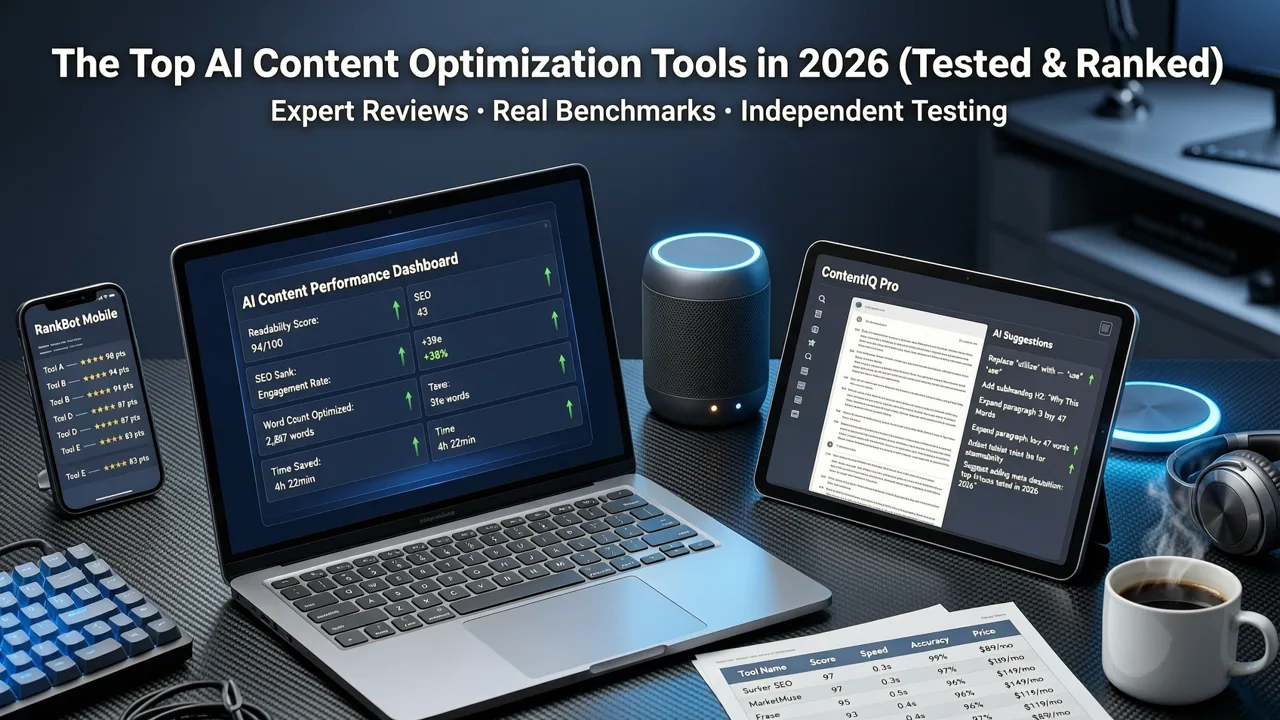
The tools below are compared on the quality of their recommendations, depth of SERP analysis, and integration options. Here's how the leading options compare.
1. MarketMuse — Best for Enterprise Content Strategy
MarketMuse continues to lead in topical authority mapping. Its AI engine identifies content gaps across your entire domain, recommends priority topics, and scores each draft against a proprietary difficulty metric. In 2026, its new intent-clustering feature groups related queries automatically, making it easier to build pillar-and-cluster architectures that actually move rankings.
- Best for: Mid-size to enterprise content teams managing 50+ pages per month.
- Key feature: Automated content briefs with entity-level recommendations.
- Limitation: Pricing scales steeply for smaller teams.
2. Surfer SEO — Best for Real-Time On-Page Optimization
Surfer's Content Editor remains one of the most intuitive tools for on-page refinement. It compares your draft with the pages that rank for your keyword and suggests what to add. The platform also integrates directly with Google Docs and WordPress.
- Best for: SEOs and content writers who need fast, actionable on-page feedback.
- Key feature: Live SERP comparison with structural gap analysis.
- Limitation: Less suited for full-domain content planning.
3. Frase — Best for Content Teams and Agencies
Frase has carved out a strong position by combining AI writing assistance with deep SERP research. Its 2026 workflow lets you go from keyword research to optimized draft in a single interface, with built-in outline generation, competitor content analysis, and automated content briefs. For agencies managing multiple clients, Frase's collaborative workspace is a standout.
- Best for: Agencies and content teams producing client deliverables.
- Key feature: End-to-end workflow from research to optimized draft.
- Limitation: AI writing quality varies by topic complexity.
4. Clearscope — Best for Content Grading Precision
Clearscope's content grading system remains the gold standard for precision. It evaluates your content against the top-ranking pages and assigns a letter grade based on term usage, readability, and topical coverage.
- Best for: Teams focused on maximizing content quality per page.
- Key feature: Entity-aware content scoring with competitive benchmarking.
- Limitation: No built-in writing assistant — primarily an optimization layer.
5. NeuronWriter — Best Budget-Friendly Option
For startups and solo marketers, NeuronWriter offers a compelling mix of NLP-based content analysis and SERP research at a fraction of the cost of enterprise tools.
- Best for: Startups and small teams with limited budgets.
- Key feature: Affordable NLP analysis with internal linking suggestions.
- Limitation: Fewer collaboration features.
How to Choose the Right AI Content Optimization Tool for Your Needs
Selecting the right platform depends on your team size, content volume, and strategic priorities. Use this decision framework to narrow your options:
| Priority | Recommended Tool | Why |
|---|---|---|
| Full-domain content strategy | MarketMuse | Topical authority mapping and automated briefs at scale |
| Fast on-page optimization | Surfer SEO | Real-time SERP comparison and intuitive editor |
| Agency workflows | Frase | Research-to-draft pipeline with client collaboration |
| Maximum content quality | Clearscope | Precision grading with entity-level analysis |
| Budget-conscious teams | NeuronWriter | Strong NLP analysis at an accessible price point |
If you're a startup evaluating your entire SEO stack, you may also want to review our guide on the best SEO tools for startups in 2026 to see how content optimization fits into a broader growth strategy.
AI Content Optimization vs. AI Content Generation: Know the Difference
A common point of confusion is the distinction between AI content optimization tools and AI content generation tools. While there's overlap, the core functions differ significantly:
- AI content generation tools produce first drafts, headlines, and meta descriptions. They focus on speed and volume.
- AI content optimization tools refine existing or drafted content for search performance, intent alignment, and technical compliance. They focus on quality and ranking potential.
The most effective content workflows in 2026 combine both. You generate a draft with an AI writer, then pass it through an optimization tool to ensure it meets SERP standards. For a deeper look at the generation side, see our breakdown of the best AI SEO content generators in 2026.
How AI Content Optimization Tools Integrate with Your SEO Workflow
These tools deliver the most value when they're embedded into a structured content workflow rather than used as standalone utilities. Here's a practical four-step process:
- Keyword and Intent Research: Identify target keywords and classify the dominant search intent. Tools like MarketMuse and Frase excel here.
- Competitive Content Analysis: Audit the top 10 results for your target query. Note their depth, structure, and any content gaps.
- Drafting and Optimization: Write your draft and run it through your optimization tool. Address the tool's recommendations for term coverage, heading structure, and content depth.
- Technical Validation: Before publishing, confirm that your on-page elements — title tags, meta descriptions, heading hierarchy, and schema markup — meet technical standards. Our guide on the best AI tools for on-page SEO covers this step in detail.
This workflow ensures that every piece of content you publish is not only well-written but also technically sound and strategically aligned with your growth objectives.
Emerging Trends in AI Content Optimization for 2026
Several trends are reshaping how these tools function and how marketers should use them:
AI Answer Engine Optimization (AEO)
With AI-powered search experiences like Google's AI Overviews and other answer engines growing in share, optimization tools now include features that help your content appear in AI-generated answers. This means structuring content for direct extraction, using clear definitions, and providing concise, factual answers to common queries.
Entity-First Content Modeling
Search engines increasingly understand content through entities — people, brands, concepts, and their relationships. Leading optimization tools now map the entity graph of your target topic and recommend which entities your content should reference to build topical depth.
Multi-Language and Localization Support
For businesses targeting international markets, the best tools now offer multilingual optimization that goes beyond translation. They adapt content structure, entity references, and local search intent patterns for each target market. If local visibility is a priority, our local SEO strategy guide covers how to adapt these tools for neighborhood-level targeting.
Content Decay Detection and Refresh Workflows
Rather than only optimizing new content, top platforms now monitor existing pages for ranking decay and recommend specific updates — new sections, refreshed data points, or restructured headings — to recover lost positions.
Common Mistakes to Avoid When Using AI Content Optimization Tools
Even the best tools can produce poor results if used incorrectly. Watch out for these pitfalls:
- Over-optimizing for term density: Hitting every recommended keyword doesn't guarantee a high score. Focus on natural coverage and user value.
- Ignoring search intent: A high optimization score means nothing if your content doesn't match what searchers actually want.
- Skipping technical checks: Optimization tools focus on content — they won't catch broken schema, slow page speed, or crawl errors. Pair them with a technical SEO audit.
- Treating the tool's score as the final word: Use the score as a directional guide, not a guarantee. Always validate with real SERP data and user engagement metrics.
Measuring the Impact of AI Content Optimization
To justify the investment in these tools, track the right metrics:
- Organic traffic growth for optimized pages over 30, 60, and 90 days post-publish.
- Keyword ranking improvements for target terms and their semantic variants.
- Click-through rate (CTR) changes in Google Search Console, which indicate whether your optimized titles and descriptions are resonating.
- Engagement signals such as time on page, scroll depth, and bounce rate.
- Content velocity: How many optimized pages your team ships per month compared to before adopting the tool.
For authoritative guidance on how Google evaluates content quality, refer to the Google Search Central documentation, and for structured data best practices, consult the Schema.org reference.
Final Thoughts: Choosing Your AI Content Optimization Stack
The right AI content optimization tools can transform your content operation from a guessing game into a data-driven growth engine. The key is to match the tool to your team's workflow, content volume, and strategic priorities — and to integrate it into a broader SEO process that includes technical validation, intent alignment, and continuous performance monitoring.
Whether you're a startup building your first content engine or an enterprise team scaling to hundreds of pages per month, the tools above represent the strongest options available in 2026. Start with a clear workflow, measure your results, and iterate based on what the data tells you.


