

What the RankOnPilot Content Audit Tool Actually Does (and Why It Matters in 2026)
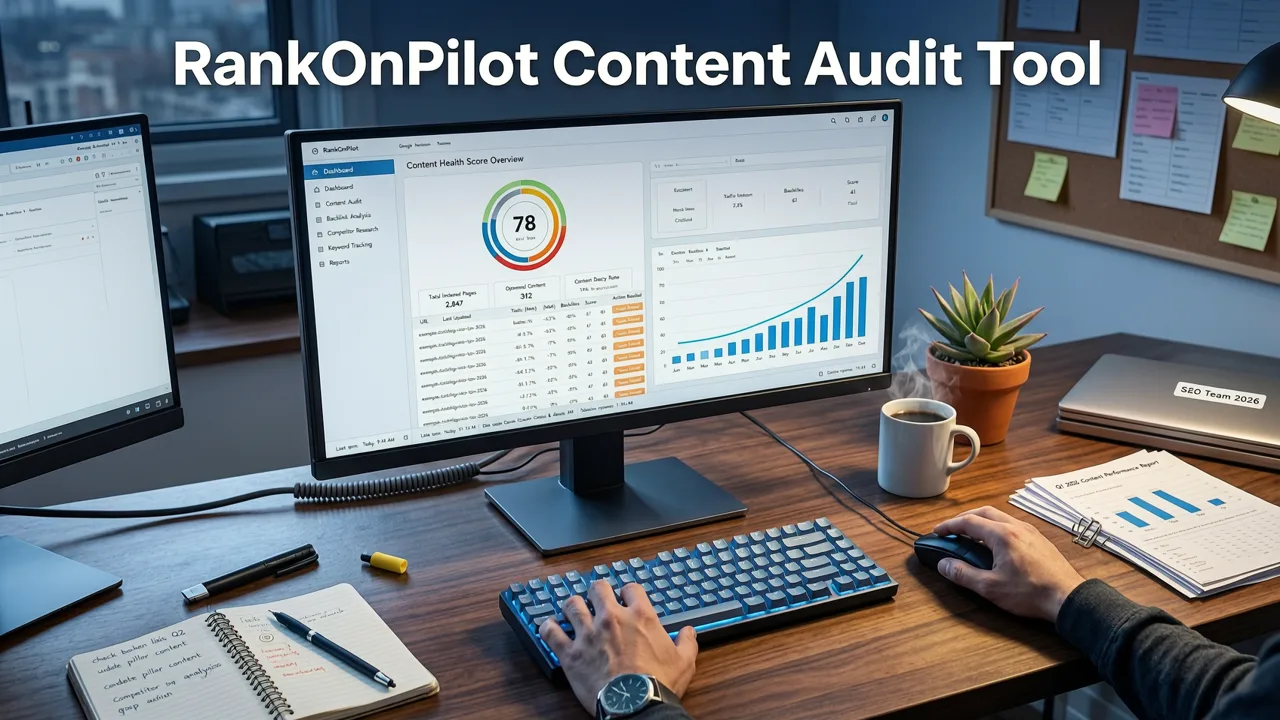
If you landed here searching for the rankonpilot content audit tool, you already know that a one-off SEO audit is no longer enough. In 2026, search engines evaluate content freshness, topical depth, and user intent alignment on a rolling basis. The RankOnPilot content audit tool is a free SEO analyzer that scans your site's content health, surfaces intent gaps, and flags technical issues that silently drain organic traffic.
This guide walks you through exactly how the tool works, what it measures, and how to turn its findings into a prioritized action plan. Whether you run a startup, an ecommerce brand, or a small local business, this walkthrough will help you use the analyzer like a seasoned SEO strategist.
Why a Content Audit Is the Foundation of Every 2026 SEO Strategy

Content audits used to be a once-a-year chore. Today, they are a continuous competitive advantage. Google's 2026 systems reward sites that demonstrate clear topical authority, remove thin or duplicated pages, and align every URL with a specific search intent. A structured audit using the rankonpilot content audit tool helps you:
- Identify pages that have lost rankings due to outdated information or weakened E-E-A-T signals.
- Find content gaps where competitors are capturing traffic you should own.
- Detect technical issues like broken internal links, missing schema, or slow-rendering pages.
- Prioritize updates that move the needle fastest, so you are not wasting hours on low-impact fixes.
Think of the audit as a diagnostic scan. It tells you what is broken, what is working, and where the biggest opportunities hide. If you want a broader view of how audits fit into a full SEO stack, our breakdown of the best SEO tools for startups in 2026 covers complementary platforms that pair well with this analyzer.
How the RankOnPilot Content Audit Tool Works: Step by Step
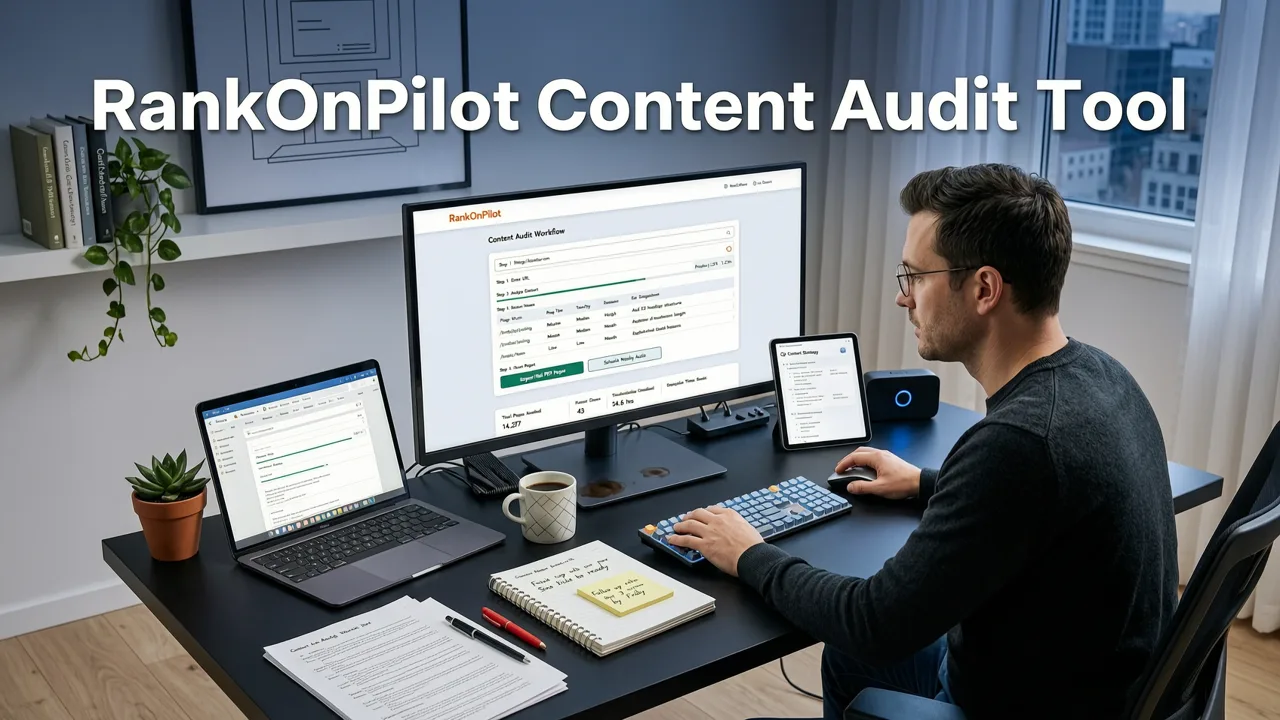
The tool follows a four-phase process designed to mirror how search engines evaluate content quality in 2026. Each phase builds on the previous one, so you get a complete picture rather than a scattered list of suggestions.
Phase 1 — Crawl and Inventory
The analyzer crawls every publicly accessible URL on your domain and builds a content inventory. It records page type, word count, heading structure, internal link count, and indexation status. This inventory becomes your baseline map.
Phase 2 — Intent and Relevance Scoring
Each page is scored against the search intent it targets. The tool checks whether the content answers the core query, includes supporting entities, and matches the depth of top-ranking competitors. Pages that drift from their target intent receive a low relevance score.
Phase 3 — Technical Health Check
Beyond content quality, the analyzer scans for technical friction points: missing meta descriptions, duplicate title tags, thin content blocks, broken internal links, and schema markup errors. These issues are ranked by estimated impact on crawl efficiency and ranking potential.
Phase 4 — Prioritized Action Plan
Finally, the tool outputs a prioritized list of recommendations. High-impact, low-effort fixes sit at the top. Strategic content expansions and restructuring tasks follow. You get a clear roadmap instead of a generic to-do list.
Key Metrics the RankOnPilot Content Audit Tool Measures
Understanding what the analyzer evaluates helps you interpret its output and make smarter decisions. Below is a summary of the core metrics and what each one tells you.
| Metric | What It Measures | Why It Matters in 2026 |
|---|---|---|
| Content Freshness Score | How recently a page was updated relative to competitors | Google rewards consistently refreshed content in fast-moving niches |
| Intent Alignment Rating | Match between page content and target search intent | Misaligned intent is the leading cause of ranking drops post-update |
| Entity Coverage | Presence of supporting topics and semantic entities | Search engines use entity graphs to judge topical completeness |
| Internal Link Health | Broken links, orphan pages, and link distribution balance | Healthy internal linking passes authority and improves crawl depth |
| Schema Compliance | Correct implementation of structured data markup | Schema unlocks rich results and helps engines understand page context |
| Readability Index | Grade-level scoring and sentence complexity analysis | Readable content retains users longer, signaling quality to algorithms |
How to Interpret Your Audit Results and Take Action
Raw data is only useful if you know what to do with it. Here is a practical framework for turning audit findings into measurable improvements.
Step 1 — Categorize Pages by Status
Group every URL into one of four buckets: Keep (performing well, minor tweaks only), Improve (solid foundation but needs refresh or expansion), Merge (thin or overlapping pages that should be consolidated), and Remove (irrelevant, cannibalizing, or permanently low-value pages). This categorization prevents you from treating every page the same way.
Step 2 — Fix Technical Issues First
Before rewriting content, resolve the technical problems the audit flagged. Broken internal links, missing schema, and duplicate meta tags create friction that no amount of content polish can overcome. Our guide on the best AI tool for on-page SEO in 2026 covers automated fixes for many of these issues.
Step 3 — Refresh High-Priority Content
Focus on pages in the "Improve" bucket that already rank on page two or the bottom of page one. These pages have proven demand. Update them with current data, add missing entities, and strengthen the introduction to better match search intent.
Step 4 — Build a Content Calendar Around Gaps
The audit will reveal topics your site does not cover at all. Map these gaps to your business goals and create a quarterly content calendar. If you need help generating optimized drafts, our ranking of the best AI SEO content generators in 2026 compares tools that integrate directly with audit insights.
RankOnPilot Content Audit Tool vs. Generic SEO Analyzers
Not all free SEO analyzers are built the same. Here is how the rankonpilot content audit tool compares to typical generic alternatives.
| Feature | RankOnPilot Content Audit Tool | Generic Free Analyzers |
|---|---|---|
| Intent-based scoring | Yes — evaluates alignment with target query intent | Rarely — most only check keyword density |
| Entity coverage analysis | Yes — maps supporting semantic topics | No — limited to surface-level keyword checks |
| Prioritized action plan | Yes — ranks fixes by estimated impact | No — provides a flat list of issues |
| Schema compliance check | Yes — validates structured data accuracy | Partial — often misses nested or JSON-LD errors |
| Content freshness benchmarking | Yes — compares against competitor update frequency | No — does not factor in competitor data |
Who Should Use the RankOnPilot Content Audit Tool?
The tool is designed for anyone responsible for organic growth, regardless of company size. Here are the most common use cases.
- Small business owners who want to understand why their site is not ranking and need a clear starting point. If local visibility is your priority, pair the audit with our local SEO for small business strategy guide.
- Startup marketing teams that need to validate their content strategy before scaling paid efforts.
- Ecommerce brands managing thousands of product and category pages that may suffer from thin content or duplicate metadata.
- Digital marketers and agency teams looking for a repeatable audit framework to use across client accounts.
Best Practices for Running a Content Audit in 2026
To get the most from the rankonpilot content audit tool, follow these practices that reflect how search engines evaluate content today.
- Audit quarterly, not annually. Search algorithms shift continuously. A quarterly cadence ensures you catch ranking drops early.
- Include archived or paused pages. Old content can still attract crawl budget and affect overall site health.
- Validate schema against official references. Cross-check your structured data with Schema.org documentation and Google Search Central guidelines to avoid markup errors.
- Track results over time. Run the audit, implement fixes, then re-audit in 90 days. Compare scores to measure the impact of your work.
- Align audit findings with business KPIs. A page with a low freshness score might not matter if it does not contribute to revenue. Prioritize pages that drive leads or sales.
Common Mistakes to Avoid When Using a Content Audit Tool
Even the best analyzer produces poor results if used incorrectly. Watch out for these pitfalls.
- Rewriting everything at once. Prioritize high-impact pages first. Spreading effort too thin dilutes results.
- Ignoring technical issues. Content improvements will underperform if the page has broken links or missing schema.
- Chasing keyword density instead of intent. Modern search engines evaluate meaning, not keyword repetition.
- Deleting pages without redirects. Removing content that still receives traffic or backlinks creates orphaned authority.
- Skipping the re-audit. Without follow-up scans, you cannot confirm whether your changes improved performance.
How Often Should You Run a Content Audit?
The ideal frequency depends on your site size and industry pace. As a general rule:
- Small sites (under 100 pages): Quarterly audits are sufficient unless you publish weekly.
- Mid-size sites (100 to 1,000 pages): Monthly audits help you stay ahead of algorithm shifts.
- Large sites (1,000+ pages): Continuous monitoring with monthly deep-dives on priority sections.
The rankonpilot content audit tool is designed to run quickly enough that even monthly scans take minutes, not hours.
Turning Audit Insights Into Long-Term Organic Growth
A content audit is not a one-time fix. It is the starting point of a continuous improvement cycle. Each audit reveals new gaps, new opportunities, and new technical issues. The sites that win in 2026 are the ones that treat auditing as a habit, not an event.
By combining the audit's findings with a disciplined content calendar, strong internal linking, and accurate schema markup, you build a site that search engines trust and users return to. That is how organic growth becomes sustainable rather than seasonal.
Final Thoughts: Start Your Audit Today
The rankonpilot content audit tool gives you a clear, data-driven view of your content's strengths and weaknesses. It removes the guesswork from SEO and replaces it with a prioritized roadmap. Whether you are fixing technical issues, refreshing outdated pages, or filling content gaps, the audit tells you exactly where to start.
Run your first scan today, implement the highest-priority fixes, and schedule your next audit for 90 days from now. Consistent, informed action is what separates sites that grow from sites that stagnate.


