

Why the Content Optimization Checklist Has Evolved in 2026
If you publish content in 2026 without running it through a modern content optimization checklist, you are leaving rankings, clicks, and revenue on the table. Search engines now evaluate pages through an intent-aware, AI-overview-ready lens — which means keyword density alone will not carry a page anymore. The short answer: a 2026 content optimization checklist must balance search intent, entity relevance, technical hygiene, and experience signals so that every asset satisfies both human readers and algorithmic evaluators in a single pass.
Content that ranks rarely does so by accident; it follows a structured optimization workflow. This guide gives you that workflow — a practical, repeatable checklist you can apply to blog posts, landing pages, product pages, and category pages alike.
The 2026 Content Optimization Checklist Framework

Think of content optimization as four layered systems rather than a flat list of tasks. Each layer builds on the previous one, and skipping a layer creates compounding friction that no single tactic can fix later.
Layer 1: Search Intent & Topic Architecture
Before you write or edit a single word, confirm the page is targeting a clearly defined search intent. In 2026, Google classifies intent into four primary modes — informational, navigational, commercial investigation, and transactional — and AI Overviews heavily favor pages that match the dominant intent of the query cluster.
- Map one primary keyword and three to five semantic variants per page. Avoid mixing informational and transactional intents on a single URL.
- Review the top ten SERP results for your target term. Note the content formats (listicles, calculators, comparison tables, videos) that dominate.
- Identify the "People Also Ask" and AI Overview prompts triggered by your keyword. These are direct signals of the subtopics your content must address.
- Confirm entity alignment. Search engines expect your page to reference the same people, brands, locations, and product types that appear in the top results. Tools like the best AI tool for on-page SEO in 2026 can surface entity gaps automatically.
Layer 2: On-Page SEO Foundations
Once intent is locked in, the on-page elements must communicate that intent unambiguously to crawlers and to AI summarization engines.
- Title tag: 50–60 characters, keyword near the front, unique across the site.
- Meta description: 130–165 characters, includes the keyword, and answers the searcher's question in one sentence.
- URL slug: Short, lowercase, hyphen-separated, keyword-included, and free of stop words.
- H1: One per page, closely aligned with the title tag but not a duplicate.
- H2 and H3 hierarchy: Logical nesting, no orphan subheadings, and each heading introduces a distinct subtopic.
- First 150 words: Deliver the core answer or value proposition immediately. AI Overviews pull heavily from this section.
- Internal links: Three to seven contextual links to relevant pillar pages and related articles. If you are building a local presence, review the Local SEO for Small Business: 2026 Strategy Guide for geo-relevant linking patterns.
- External citations: Link to authoritative sources such as Google Search Central documentation when referencing technical guidelines.
Layer 3: Content Depth, Readability & Experience
Depth without clarity is just noise. In 2026, search evaluators reward pages that combine comprehensive coverage with effortless readability.
- Target word count based on intent, not a fixed number. Informational guides typically perform between 1,500 and 3,000 words; transactional pages convert better at 600–1,000 words.
- Use short paragraphs (two to four sentences) and varied sentence length to maintain rhythm.
- Include at least one visual aid — a comparison table, chart, diagram, or embedded video — every 400 to 600 words.
- Add original insights: proprietary data, expert quotes, screenshots, or case studies. Generic AI-generated paragraphs without unique perspective are increasingly filtered out.
- Optimize for accessibility: descriptive alt text, sufficient color contrast, and semantic HTML.
- Mobile-first formatting: confirm that tables scroll horizontally, fonts are legible, and tap targets meet minimum size requirements.
Layer 4: Technical & Structured Data Layer
The final layer ensures that search engines can index, classify, and surface your content without friction.
- Schema markup: Implement Article, FAQ, HowTo, Product, or BreadcrumbList schema as appropriate. Reference Schema.org for the latest property definitions.
- Core Web Vitals: Largest Contentful Paint under 2.5 seconds, Interaction to Next Paint under 200 milliseconds, and Cumulative Layout Shift under 0.1.
- Crawlability: Verify that the page is not blocked by robots.txt, has a self-referencing canonical tag, and appears in your XML sitemap.
- Render stability: If you use client-side JavaScript, confirm that critical content is available in the initial HTML response.
- HTTPS and security headers: Non-negotiable for ranking and trust signals.
The Full Content Optimization Checklist at a Glance
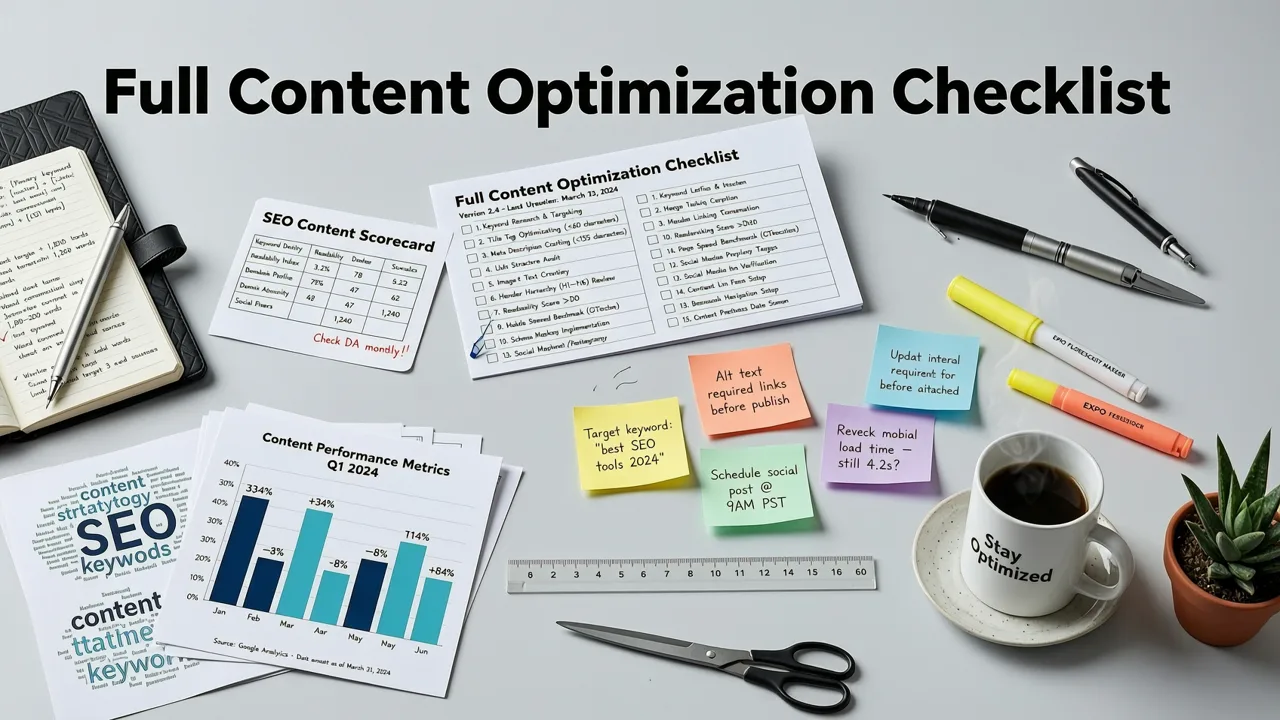
Use the table below as a quick-reference audit tool. Each item should be checked before a page goes live and revisited quarterly.
| Category | Task | Status |
|---|---|---|
| Intent | Primary keyword and intent confirmed | ☐ |
| Intent | Semantic variants mapped (3–5) | ☐ |
| Intent | PAA and AI Overview prompts addressed | ☐ |
| On-Page | Title tag optimized (50–60 chars) | ☐ |
| On-Page | Meta description written (130–165 chars) | ☐ |
| On-Page | URL slug clean and keyword-included | ☐ |
| On-Page | H1 unique and aligned with title | ☐ |
| On-Page | H2/H3 hierarchy logical, no orphans | ☐ |
| On-Page | First 150 words deliver core answer | ☐ |
| On-Page | 3–7 contextual internal links added | ☐ |
| Content | Word count matches intent | ☐ |
| Content | Visual aid included per 400–600 words | ☐ |
| Content | Original insights or data present | ☐ |
| Content | Accessibility and alt text verified | ☐ |
| Technical | Schema markup implemented | ☐ |
| Technical | Core Web Vitals within thresholds | ☐ |
| Technical | Canonical tag and sitemap confirmed | ☐ |
| Technical | HTTPS active, no mixed content | ☐ |
How AI Overviews Change the Way You Optimize Content
AI Overviews now appear in a significant share of informational and commercial queries. They do not replace organic rankings — they sit above them and often pull directly from the pages that best answer the query in a concise, structured format. This changes optimization priorities in three ways:
- Answer-first structure wins. Pages that lead with a direct, plain-language answer in the first paragraph are more likely to be cited.
- Definition and list formatting matters. Use clear definition sentences, numbered steps, and comparison tables. These formats are easiest for AI systems to parse and recombine.
- Authority signals carry more weight. Author bylines, cited sources, and original data help your content stand out from the flood of generic AI-generated pages.
If you are scaling content production with AI, pair your workflow with the best AI SEO content generator in 2026 to ensure output is reviewed against this checklist before publication.
Content Optimization for Different Page Types
Not every page follows the same optimization pattern. Adjust the checklist emphasis based on the page's role in your funnel.
Blog Posts and Informational Guides
Prioritize intent clarity, comprehensive coverage, and internal linking to pillar pages. These pages build top-of-funnel authority and feed AI Overview citations.
Product and Ecommerce Pages
Focus on unique product descriptions, structured data (Product, Review, Offer schema), high-quality images with descriptive alt text, and clear calls to action. Avoid manufacturer-supplied copy that duplicates other sites.
Service and Landing Pages
Emphasize unique value propositions, trust signals (testimonials, case studies, certifications), and friction-free conversion elements. Keep word count lean and scannable.
Local Business Pages
Include location-specific content, embedded maps, LocalBusiness schema, and proximity-relevant keywords. For a deeper dive, the best SEO tools for startups in 2026 can help you audit local visibility at scale.
Common Content Optimization Mistakes to Avoid in 2026
Even experienced marketers fall into patterns that undermine their results. Watch for these pitfalls:
- Keyword stuffing. Repeating the target phrase unnaturally triggers spam signals and degrades readability.
- Ignoring search intent shifts. A keyword that was informational last year may have moved to commercial intent as the market matured. Recheck SERP features quarterly.
- Publishing thin or duplicated content. AI-generated pages without editorial oversight create cannibalization and dilute crawl budget.
- Neglecting internal linking. Orphan pages receive minimal crawl attention and pass no equity to the rest of the site.
- Skipping schema markup. Structured data remains one of the highest-ROI technical investments for rich results and AI citation.
- Overlooking page experience. Slow load times, intrusive interstitials, and layout shifts suppress engagement metrics that influence rankings.
Building a Repeatable Content Optimization Workflow
A checklist is only valuable if your team uses it consistently. Here is a simple workflow to embed it into your production process:
- Brief stage: Complete the intent and topic architecture layer before writing begins.
- Draft stage: Writer follows the on-page and content depth guidelines in real time.
- Edit stage: Editor runs the full checklist, flags gaps, and requests revisions.
- Pre-publish stage: Technical SEO verifies schema, Core Web Vitals, and crawlability.
- Post-publish stage: Monitor performance at 30, 60, and 90 days. Refresh content that shows declining engagement or impressions.
Documenting this workflow in your content management system ensures accountability and makes onboarding new writers faster.
Measuring the Impact of Content Optimization
Optimization is not a one-time event — it is a cycle. Track these metrics to confirm that your checklist is driving results:
- Organic traffic growth by page and by intent cluster.
- Keyword ranking movement for primary and semantic terms.
- Click-through rate from search results, indicating title and meta description effectiveness.
- Engagement metrics: time on page, scroll depth, and bounce rate.
- Conversion rate for pages with transactional or lead-generation goals.
- AI Overview citation frequency, where measurable through SERP monitoring tools.
When a page underperforms, return to the checklist. In most cases, the gap lies in one of the four layers — intent misalignment, weak on-page signals, shallow content, or technical friction.
Final Thoughts: Optimization Is a Competitive Advantage
In 2026, the web is saturated with content. The pages that win are not the longest or the most numerous — they are the most precisely aligned with what searchers need and how search engines evaluate quality. A disciplined content optimization checklist turns that alignment into a repeatable process, and a repeatable process turns into compounding organic growth.


