

What It Takes to Win Featured Snippets in 2026

If you want to know how to optimize content for featured snippets in 2026, the short answer is this: write clear, direct answers to specific questions, structure your content so search engines can extract those answers instantly, and align every page with the exact user intent behind the query. Featured snippets remain one of the highest-value placements in organic search, and in 2026 they appear more frequently, cover more query types, and favor content that demonstrates genuine expertise over keyword-matching tricks.
Featured snippets, often called "position zero," sit above the first organic result and pull directly from your page content. Winning one can increase click-through rates and visibility — especially when paired with strong E-E-A-T signals. This guide builds on our guide to how to optimize content for search engines, adapted specifically for featured snippets.
How Featured Snippets Work in 2026
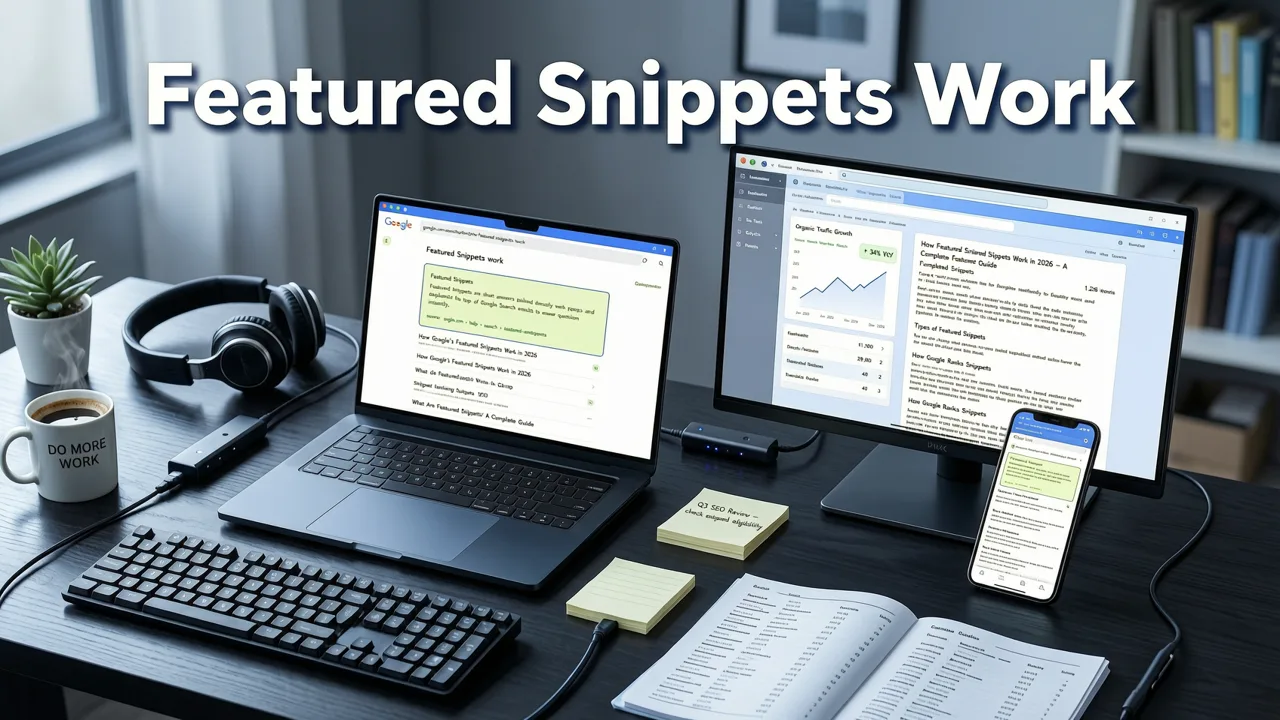
Google's documentation on featured snippets says its systems "determine whether a page would make a good featured snippet" for a search, and that you can't mark a page to become one. What you can do is make the answer easy to find and quote.
Understanding the mechanics is the first step toward optimization. Here is what the algorithm prioritizes:
- Direct answer clarity: A concise, standalone sentence or block that answers the query without requiring surrounding context.
- Structural formatting: Proper use of headings, lists, and tables that make extraction straightforward.
- Topical authority: Content that demonstrates depth on the subject, not just surface-level definitions.
- Entity recognition: Clear identification of people, places, products, and concepts using structured data and natural language.
- Freshness and accuracy: Updated information that reflects current facts, pricing, and best practices.
The Three Featured Snippet Formats You Need to Target
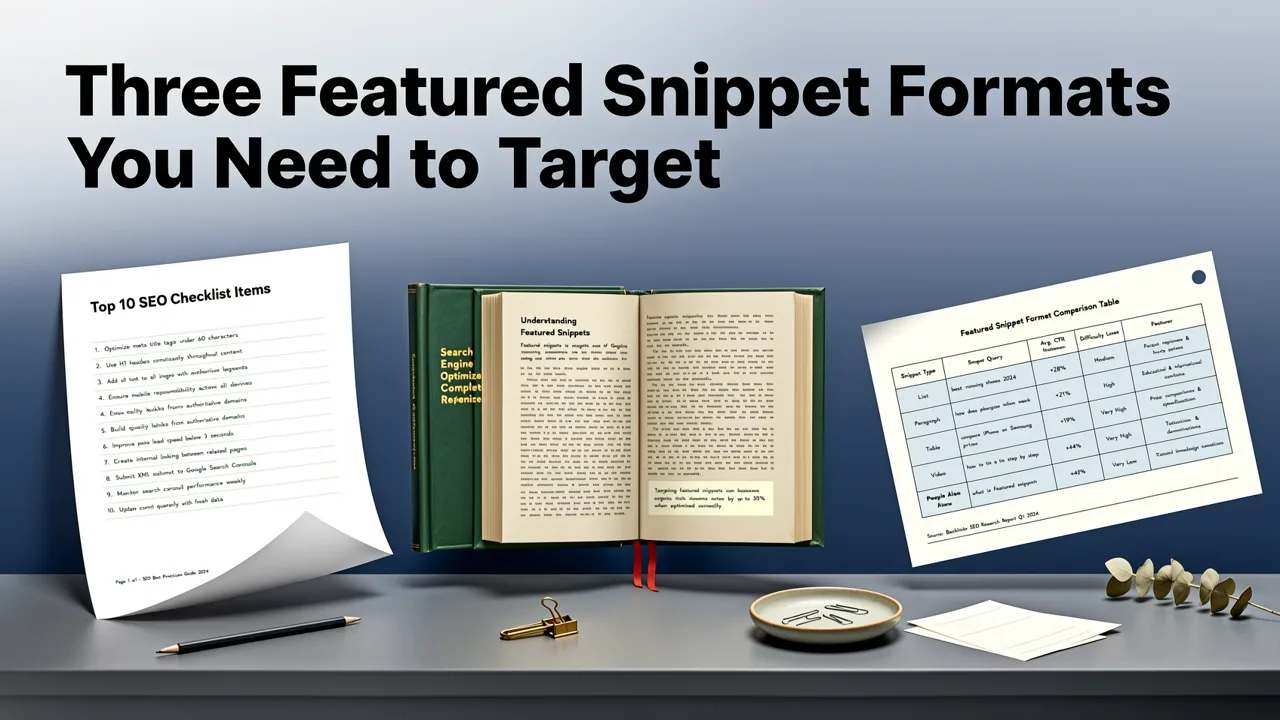
Not all snippets are created equal. In 2026, Google predominantly serves three formats, each requiring a different optimization approach. Knowing which format to target for a given query is half the battle.
Paragraph Snippets (Definition Answers)
Paragraph snippets typically appear for "what is," "who is," "why does," and "how does" queries. They display 40 to 60 words of text pulled from a single passage on your page. To optimize for paragraph snippets, place a direct, 40-to-60-word answer immediately after a heading that matches the query intent. Avoid burying the answer in introductory fluff.
Example structure:
- H2 or H3: "What Is Technical SEO?"
- First paragraph: A clear, self-contained definition that directly answers the question in one to three sentences.
- Following paragraphs: Supporting detail, examples, and context.
List Snippets (Steps, Rankings, and Items)
List snippets appear for "how to," "steps to," "best," and "top" queries. Google extracts ordered or unordered lists directly from your HTML. To win list snippets, use properly formatted <ol> or <ul> elements with concise, action-oriented items. Each list item should be a complete thought — ideally one sentence — that stands alone when pulled out of context.
Best practices for list snippet optimization:
- Start each list item with a verb or a clear noun phrase.
- Keep items between 8 and 15 for most queries.
- Use a heading that explicitly signals a list format, such as "7 Steps to Optimize Content for Featured Snippets."
- Avoid nested lists unless the query specifically demands sub-steps.
Table Snippets (Comparisons, Data, and Specifications)
Table snippets serve queries involving comparisons, pricing, specifications, and data. They pull structured HTML tables and display them with sortable columns in many cases. To optimize for table snippets, ensure your data is presented in clean <table> markup with descriptive <th> headers and concise cell content.
Step-by-Step Framework to Optimize Content for Featured Snippets
Now that you understand the formats, here is the operational framework. This process works whether you are writing new content or reverse-engineering existing pages for snippet opportunities.
Step 1: Identify Snippet Opportunities Through Keyword Research
Not every keyword has a featured snippet, and not every page is a candidate. Start by filtering your keyword list for queries that already trigger a snippet. Look for question-based queries, comparison queries, and "how to" phrases. Tools that analyze SERP features will show you which keywords currently display snippets and which ones you can realistically compete for.
Focus on keywords where:
- You already rank on page one (positions 1 through 10).
- The current snippet is weak, outdated, or pulled from a low-authority source.
- The query has clear informational intent.
Step 2: Reverse-Engineer the Current Snippet
Analyze the page that currently holds the snippet. Note its word count for the answer passage, its heading structure, its formatting, and its depth. Your goal is not to copy it — it is to produce a clearly better, more precise, and better-structured answer. If the current snippet is a paragraph, can you deliver a cleaner one? If it is a list, can you make yours more actionable?
Step 3: Write the Answer Block First
Before writing the rest of the article, draft the answer block — the 40-to-60-word passage or the list that directly answers the target query. This ensures your content is built around the snippet, not the other way around. Place this block immediately below a heading that mirrors the query.
If you are using AI-assisted writing workflows, platforms like the ones reviewed in our best AI SEO content writer 2026 roundup can help generate precise answer blocks when prompted with intent-first instructions rather than raw keywords.
Step 4: Structure the Surrounding Content for Context
The answer block needs context to earn trust. After the direct answer, expand with supporting paragraphs that explain the "why," provide examples, address edge cases, and link to related topics. This depth signals topical authority and gives the algorithm confidence that your page is a comprehensive resource.
Step 5: Apply Structured Data and Schema Markup
While structured data does not directly trigger featured snippets, it helps search engines understand your content's entities and relationships. Use Schema.org markup for FAQs, HowTo steps, and other relevant content types. This reinforces the semantic clarity of your page and can make the page eligible for some rich results, though Google has cut back FAQ and HowTo rich results sharply since 2023.
Step 6: Optimize for E-E-A-T Signals
E-E-A-T (Experience, Expertise, Authoritativeness, Trustworthiness) is what Google’s quality raters look for, and showing it also helps readers trust your answer. Strengthen your E-E-A-T by including author bios with verifiable credentials, citing reputable sources, displaying editorial standards, and ensuring your content reflects first-hand experience rather than aggregated summaries.
For teams building content at scale, integrating E-E-A-T layers into your workflow is essential. Our analysis of AI content writer for SEO tools highlights how modern platforms now embed trust signals directly into the generation process.
Step 7: Format for Extraction
Clean HTML formatting is non-negotiable. The algorithm extracts content based on DOM structure, so your headings, lists, and tables must be semantically correct. Avoid wrapping answer passages in unnecessary divs, avoid using images where text would serve better, and ensure your heading hierarchy is logical and unbroken.
Featured Snippet Optimization Checklist
Use this checklist before publishing any page targeting a snippet opportunity:
| Optimization Element | Requirement | Status |
|---|---|---|
| Target query identified | Question-based or comparison query with active snippet | ☐ |
| Answer block drafted | 40–60 words for paragraphs, 8–15 items for lists | ☐ |
| Heading matches query intent | H2 or H3 mirrors the user's question | ☐ |
| HTML formatting is clean | Proper <ol>, <ul>, <table>, and heading tags | ☐ |
| E-E-A-T signals present | Author bio, citations, editorial standards | ☐ |
| Schema markup applied | FAQ, HowTo, or relevant schema types | ☐ |
| Content is current | Reflects 2026 data, pricing, and best practices | ☐ |
| Mobile readability verified | Short paragraphs, scannable layout | ☐ |
Common Mistakes That Prevent Snippet Acquisition
Even well-optimized content can fail to earn a snippet if certain mistakes creep in. Here are the most common pitfalls:
- Answer buried in a long introduction: If the algorithm has to scroll past three paragraphs of context to find your answer, it will likely choose a competitor's cleaner passage.
- Vague or overly broad answers: Snippets reward precision. "SEO is important for businesses" will never win a snippet. "SEO is the practice of optimizing web content to rank in search engines and attract organic traffic" will.
- Poor heading structure: If your answer does not sit under a heading that matches the query, the algorithm may not associate the passage with the question.
- Missing formatting: Unformatted text blocks, bullet points rendered as plain text instead of proper list markup, and data presented in paragraphs instead of tables all reduce extraction likelihood.
- Thin supporting content: A standalone answer without depth signals low authority. The surrounding content must demonstrate expertise.
How to Optimize Existing Content for Featured Snippets
You do not always need to create new content. Many of the highest-impact snippet wins come from optimizing pages that already rank on page one. Here is the process:
- Identify pages ranking in positions 2 through 10 for query terms that trigger snippets.
- Determine the snippet format currently displayed and analyze the competing passage.
- Rewrite the relevant section of your page to include a cleaner, more precise answer block directly beneath a matching heading.
- Update the HTML formatting to ensure proper list, table, or paragraph structure.
- Add or refresh E-E-A-T signals, including citations, author information, and last-updated dates.
- Submit the updated page for reindexing and monitor SERP changes over the following two to four weeks.
This approach often yields faster results than building new pages from scratch, since the page already has ranking signals and topical relevance established.
Featured Snippets vs. AI Overviews: What Changed in 2026
A common question in 2026 is whether AI Overviews have replaced featured snippets. The answer is no — they coexist. AI Overviews tend to appear for broader, more complex queries that require synthesis, while featured snippets remain dominant for precise, factual, and definitional queries. Optimizing for featured snippets still drives significant visibility, and the tactics that earn snippets also improve your chances of being cited within AI Overviews.
The key difference: AI Overviews pull from multiple sources and synthesize answers, while a featured snippet shows a single source. To maximize both, ensure your content is precise enough for snippets and comprehensive enough for AI synthesis.
Measuring Featured Snippet Performance
Once you have optimized your content, tracking performance is essential. Monitor the following metrics:
- Snippet acquisition rate: The percentage of targeted queries where your page earns the snippet.
- Organic CTR changes: Snippets can increase or decrease click-through depending on query type. Track both.
- Impression share: Even without the snippet, appearing on the same SERP as a snippet you previously held indicates competitive pressure.
- Engagement metrics: Bounce rate, time on page, and downstream conversions reveal whether snippet traffic is qualified.
Use rank tracking tools that specifically monitor SERP features, not just positional rankings. Position one without a snippet and position three with a snippet can produce vastly different outcomes.
Final Thoughts on Winning Position Zero
Learning how to optimize content for featured snippets in 2026 is ultimately about precision, structure, and trust. The algorithm rewards content that answers questions directly, presents information in extractable formats, and demonstrates real expertise. There are no shortcuts — but the framework above gives you a repeatable process for earning and retaining position zero across your most valuable queries.
Ready to start winning featured snippets for your highest-value keywords? Audit your current page-one content, apply the framework above, and measure the results. Position zero is within reach — but only if your content is built to earn it.


