

Top SEO Content Optimizer Plugins for WordPress in 2026
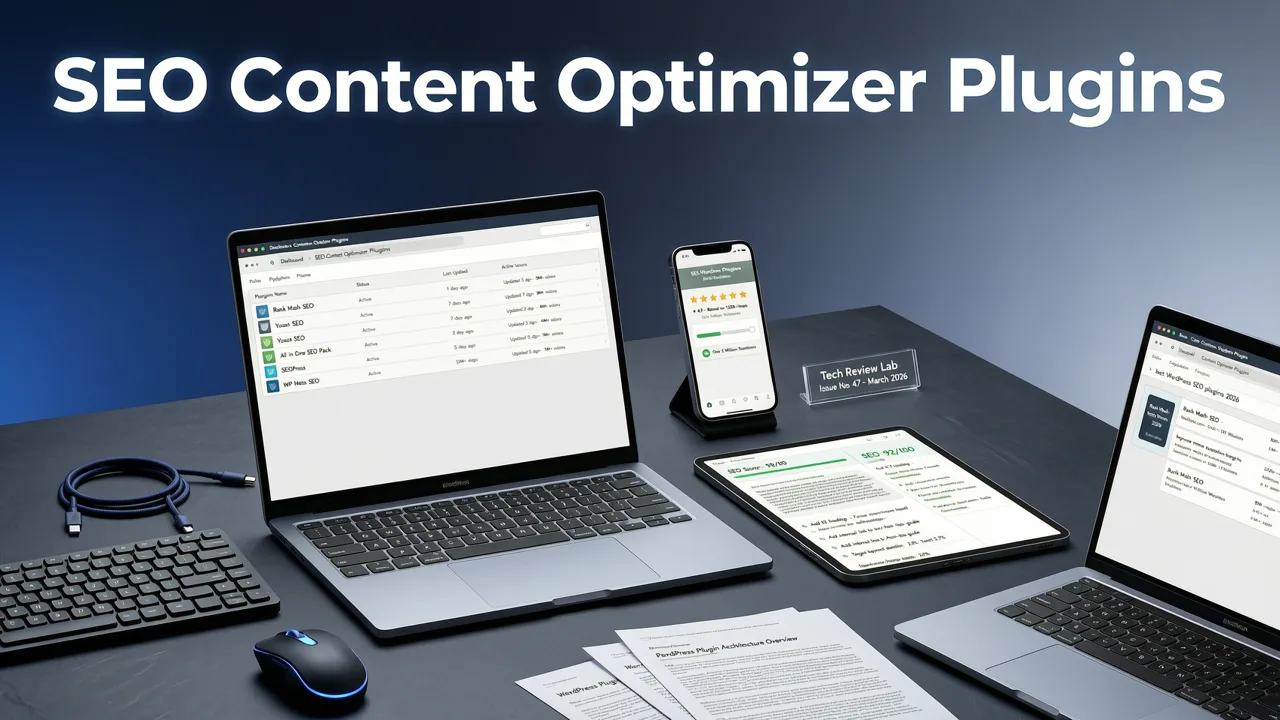
If you are searching for the right SEO content optimizer plugin in 2026, you already know the game has changed. Google's search algorithms now reward depth, topical authority, and user-first writing — not keyword stuffing or thin checklist optimization. The right plugin should act like an embedded strategist inside your WordPress editor, guiding you toward content that ranks, converts, and earns links.
This guide compares the top SEO content optimizer plugins available for WordPress right now, evaluates their real-world performance, and shows you how to pick the one that fits your workflow, team size, and growth goals.
What an SEO Content Optimizer Plugin Actually Does in 2026
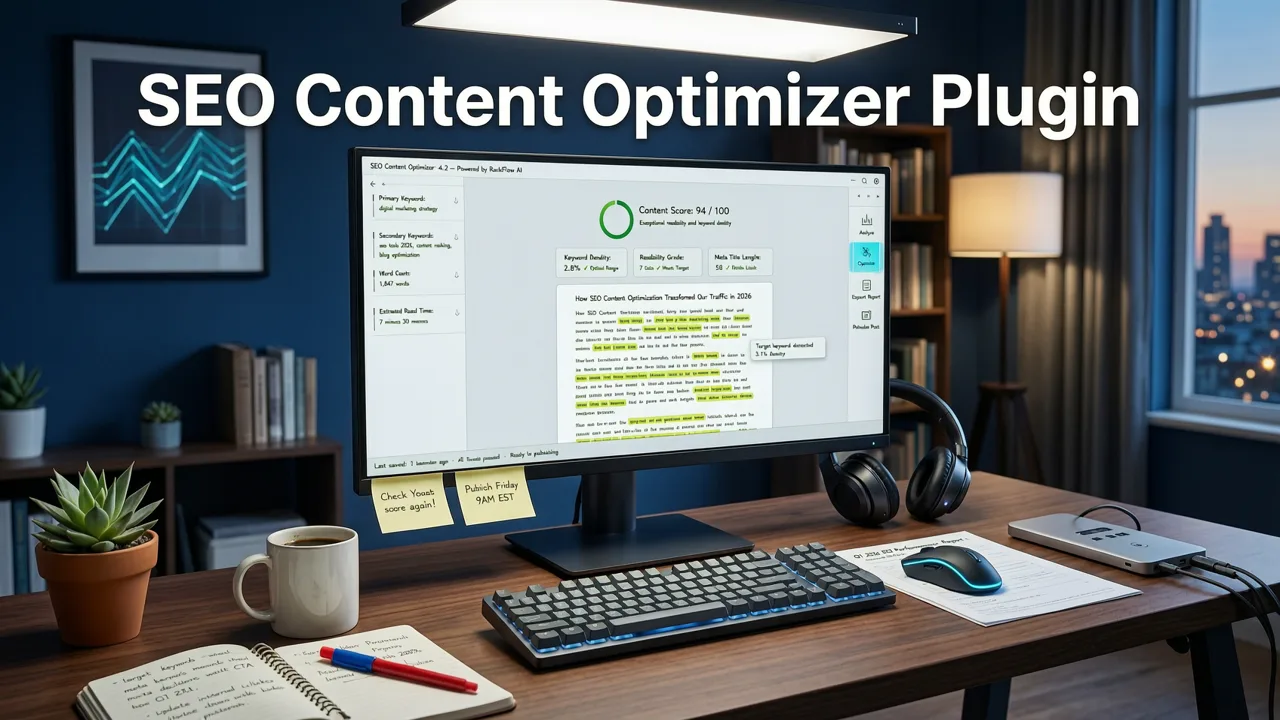
An SEO content optimizer plugin is a WordPress tool that analyzes your draft or published content against your target keyword, related search intent, and on-page ranking signals — then provides actionable recommendations to improve your chances of ranking. In 2026, the best plugins go far beyond green-light checklists. They analyze semantic relevance, entity coverage, readability, internal linking potential, and even schema readiness.
The Core Functions to Expect
- Keyword and NLP analysis: Evaluates your content against top-ranking pages using natural language processing and entity recognition.
- Real-time scoring: Provides a live optimization score as you write or edit in WordPress.
- Content briefs: Generates outlines, suggested headings, and subtopic coverage based on SERP data.
- On-page SEO checks: Validates title tags, meta descriptions, heading hierarchy, image alt text, and internal linking.
- Readability and UX signals: Flags dense paragraphs, passive voice, and mobile-unfriendly formatting.
- Schema and structured data guidance: Helps you add FAQ, HowTo, Article, and other rich-result markup.
Why the Best SEO Content Optimizer Plugin in 2026 Is Not Just About Keywords
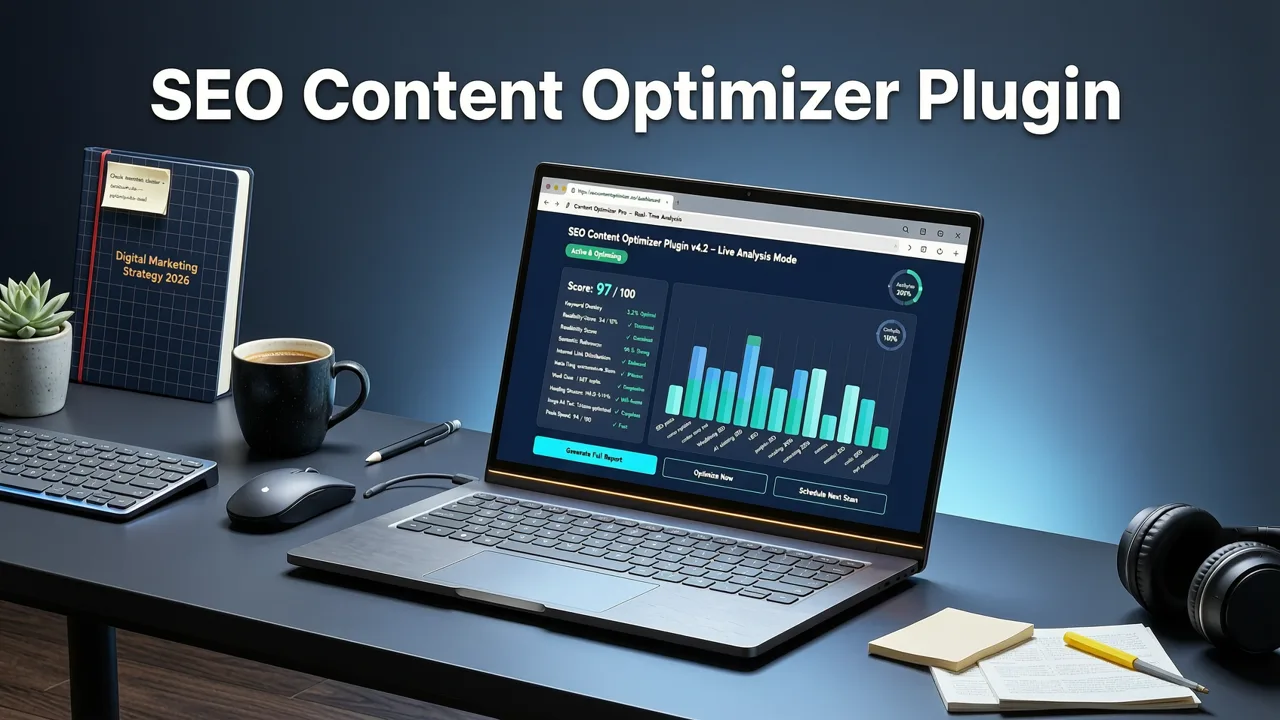
If your evaluation criteria still revolve around keyword density and a simple traffic-light score, you are optimizing for a version of Google that no longer exists. The 2026 search landscape is shaped by AI Overviews, entity-based understanding, and a heavy emphasis on E-E-A-T. Your content optimizer plugin needs to reflect that reality.
What Has Changed
Google's systems now prioritize helpful, people-first content that demonstrates firsthand experience and topical depth. A plugin that only checks keyword frequency will lead you to produce content that looks optimized but fails to compete. The best tools in 2026 analyze the semantic landscape of your target query — the entities, questions, and subtopics that top-ranking pages collectively cover — and help you match or exceed that coverage.
What to Look For
- SERP-aware analysis: The plugin should pull live data from actual search results, not rely on static keyword databases.
- Entity and topic coverage: It should identify the key concepts, brands, people, and ideas that top pages discuss.
- Intent alignment: It should flag whether your content matches the dominant search intent — informational, commercial, navigational, or transactional.
- Integration with your workflow: It should live inside your WordPress editor, not require context-switching to a separate dashboard.
- Actionable recommendations: Scores without guidance are useless. The plugin should tell you exactly what to add, remove, or restructure.
Top 7 SEO Content Optimizer Plugins for WordPress in 2026
Each plugin below is compared on optimization accuracy, ease of use, WordPress integration depth, AI capabilities, pricing, and fit for different team sizes.
1. Surfer SEO Content Editor (WordPress Integration)
Best for: Content teams and agencies managing high-volume publishing.
Surfer remains one of the most widely used SEO content optimization platforms in 2026. Its WordPress integration lets you pull the Content Editor directly into your post editor, where it provides a real-time optimization score based on comparison with top-ranking pages. Surfer analyzes term frequency, heading structure, word count benchmarks, paragraph length, image count, and internal linking patterns.
Strengths
- Deep SERP-based analysis with live data refresh.
- Content Editor provides granular, section-by-section recommendations.
- Integrates with Surfer's keyword research and content audit tools.
- Strong audit feature for refreshing older content.
Limitations
- Priced per seat — costs add up for larger teams.
- Interface can feel dense for beginners.
2. MarketMuse Content Optimizer
Best for: Enterprise content operations and topical authority building.
MarketMuse takes a fundamentally different approach. Instead of optimizing one page at a time, it maps your entire site's topical coverage and identifies content gaps. Its WordPress plugin surfaces optimization recommendations within the editor, including suggested entities, related topics, and internal linking opportunities.
Strengths
- Site-wide topical authority analysis — not just single-page optimization.
- AI-generated content briefs that reflect true search intent.
- Automated internal linking suggestions based on topical relevance.
- Excellent for agencies managing large content portfolios.
Limitations
- Higher price point; best suited for teams with significant content budgets.
- Learning curve for the full platform.
3. Frase Content Optimizer
Best for: Small teams and solo marketers who want an all-in-one workflow.
Frase combines content research, outline generation, and on-page optimization in a single platform. Its WordPress plugin delivers a streamlined optimization interface inside the editor, showing you a target score, recommended terms, and content structure suggestions.
Strengths
- Affordable pricing with generous feature access.
- AI-powered outline and draft generation built in.
- Clean, beginner-friendly interface.
- Strong SERP research and question-harvesting features.
Limitations
- Less granular entity-level analysis compared to MarketMuse.
- Content audit features are less mature than Surfer's.
4. Yoast SEO Premium
Best for: WordPress users who want a familiar, all-in-one SEO plugin with added content guidance.
Yoast SEO is the most installed SEO plugin in the WordPress ecosystem. In 2026, Yoast Premium adds AI-assisted content optimization suggestions, improved readability analysis, and enhanced schema markup support. While it is not as SERP-data-driven as dedicated optimization platforms, it remains a strong choice for users who want everything in one plugin.
Strengths
- Extremely familiar interface — most WordPress users already know it.
- Strong technical SEO features: XML sitemaps, breadcrumbs, canonical tags.
- AI-powered meta description and title generation.
- Excellent structured data and schema support.
Limitations
- Content optimization is less SERP-aware than dedicated tools.
- Does not analyze top-ranking competitors in real time.
5. Rank Math Pro
Best for: Technical SEO practitioners who want deep WordPress control.
Rank Math has grown into a serious competitor to Yoast, offering more advanced technical features at a lower price point. Its content analysis module provides keyword-focused scoring, readability checks, and schema integration. Rank Math Pro adds advanced tools like 404 monitoring, redirection management, and detailed analytics integration.
Strengths
- Generous free tier; Pro is competitively priced.
- Advanced technical SEO controls built in.
- Content AI module provides optimization suggestions.
- Lightweight performance impact on WordPress.
Limitations
- Content optimization features are less sophisticated than Surfer or MarketMuse.
- Interface has many features, which can overwhelm new users.
6. Clearscope WordPress Plugin
Best for: Premium content teams focused on quality over volume.
Clearscope is known for its high-quality content grading, built on IBM Watson NLP technology. Its WordPress plugin brings the optimization interface directly into your editor, showing you a content grade, recommended terms with usage guidance, and competitor comparison data.
Strengths
- Highly accurate NLP-based content grading.
- Excellent competitor content analysis.
- Clean, focused interface that reduces distraction.
- Trusted by top-tier content marketing teams.
Limitations
- Premium pricing — not ideal for small budgets.
- Fewer auxiliary features compared to all-in-one platforms.
7. NeuronWriter
Best for: Budget-conscious marketers who still want SERP-aware optimization.
NeuronWriter has emerged as a strong value option in 2026. It uses Google's NLP API to analyze top-ranking content and provides optimization recommendations directly in its WordPress integration. It offers content scoring, suggested terms, SERP analysis, and even AI-assisted writing suggestions.
Strengths
- Very affordable compared to enterprise alternatives.
- SERP-aware analysis with NLP-backed recommendations.
- Built-in AI writing assistance.
- Content planning and internal linking features.
Limitations
- Smaller team and slower feature iteration than larger competitors.
- Interface is functional but less polished.
Head-to-Head Comparison Table
Here is a side-by-side comparison to help you decide which SEO content optimizer plugin fits your needs.
| Plugin | Best For | SERP Analysis | AI Features | Starting Price (Monthly) | WordPress Integration |
|---|---|---|---|---|---|
| Surfer SEO | Content teams & agencies | Yes — live | AI writer, audit | $89 | Native editor integration |
| MarketMuse | Enterprise & topical authority | Yes — live | AI briefs, auto-links | $149 | Plugin with in-editor scoring |
| Frase | Solo marketers & small teams | Yes — live | AI outlines & drafts | $15 | Editor integration |
| Yoast Premium | General WordPress SEO | Limited | AI meta & titles | $12.99 | Full native plugin |
| Rank Math Pro | Technical SEO practitioners | Limited | Content AI module | $6.58 | Full native plugin |
| Clearscope | Premium content teams | Yes — NLP-based | Content grading | $170 | Editor plugin |
| NeuronWriter | Budget-conscious marketers | Yes — NLP-based | AI writing assist | $9 | WordPress integration |
How to Choose the Right SEO Content Optimizer Plugin for Your Business
The best plugin depends on your team size, content volume, budget, and optimization maturity. Here is a decision framework.
For Solo Bloggers and Small Sites
If you publish a few posts per month and need straightforward guidance, Yoast SEO or Rank Math will cover your technical SEO needs. Add Frase or NeuronWriter if you want SERP-aware content optimization without enterprise pricing.
For Growing Content Teams
If you have multiple writers and publish weekly, Surfer SEO offers the best balance of depth, workflow integration, and team features. Its content audit tool is especially valuable for refreshing older posts — a strategy that often delivers faster results than publishing new content. Learn more about content generation workflows in our guide to the best AI SEO content generators in 2026.
For Agencies and Enterprise Operations
If you manage dozens or hundreds of pages across multiple clients, MarketMuse provides the site-wide topical intelligence that single-page tools cannot match. Its ability to map content gaps and automate internal linking recommendations saves significant time at scale.
For E-commerce Brands
E-commerce sites need optimization that extends beyond blog content to product pages, category pages, and collection descriptions. Pair a technical SEO plugin like Rank Math with a content optimizer like Surfer or Frase to cover both product-level and editorial content.
How to Use an SEO Content Optimizer Plugin Effectively in 2026
Having the right tool is only half the equation. How you use it determines whether you produce content that actually ranks. Follow these steps to get maximum value from your SEO content optimizer plugin.
Step 1: Start With Keyword and Intent Research
Before you open your optimizer, make sure you understand the search intent behind your target keyword. Is the searcher looking to learn, compare, buy, or navigate? Your content must match that intent — no optimizer can fix a fundamental intent mismatch. If you need a structured approach, our guide on increasing organic search traffic in 2026 covers intent architecture in detail.
Step 2: Generate or Import a Content Brief
Most optimizer plugins can generate a content brief based on SERP analysis. Review it critically. Does it cover the questions your audience actually asks? Does it include the subtopics that top-ranking pages address? Adjust the brief before you start writing.
Step 3: Write First, Optimize Second
Do not let the optimizer's real-time score dictate your writing flow. Draft your content naturally, then use the plugin's recommendations to refine structure, add missing subtopics, and improve semantic coverage. Writing for a score produces robotic content; writing for the reader and then optimizing produces content that ranks and converts.
Step 4: Validate Technical On-Page Elements
Use your plugin to verify that your title tag, meta description, heading hierarchy, image alt attributes, and internal links are properly configured. These fundamentals still matter in 2026. Our technical SEO audit checklist provides a complete framework for validating these elements across your entire site.
Step 5: Add Structured Data Where Relevant
If your content answers questions, provides step-by-step instructions, or includes reviews, add the appropriate schema markup. Many optimizer plugins now guide you through this process. Structured data does not directly boost rankings, but it increases your visibility in rich results and AI Overviews.
Step 6: Monitor, Iterate, and Refresh
Content optimization does not end at publish. Track your rankings, organic traffic, and engagement metrics. Use your optimizer's audit features to identify pages that are losing position and refresh them with updated data, new subtopics, and improved structure.
Common Mistakes to Avoid With SEO Content Optimizer Plugins
Even the best plugin can lead you astray if you rely on it blindly. Watch out for these common pitfalls.
- Chasing a perfect score: A 100/100 optimization score does not guarantee rankings. Use the score as a directional guide, not a target.
- Ignoring search intent: If the top results are product pages and you write a blog post, no amount of term optimization will help.
- Over-optimizing: Forcing in every suggested term produces unnatural content that readers bounce from. Relevance matters more than volume.
- Neglecting technical SEO: A perfectly optimized article on a slow, crawl-error-ridden site will underperform. Technical foundations come first.
- Skipping the human edit: AI-assisted optimization is powerful, but final content should always be reviewed by a human editor for accuracy, tone, and brand voice.
The Role of AI in SEO Content Optimization in 2026
AI has transformed how we approach content optimization. Modern plugins use large language models and NLP engines to understand what top-ranking content covers, predict which subtopics you are missing, and even suggest phrasing improvements. However, AI is a tool — not a replacement for strategic thinking. The most successful content teams in 2026 use AI-powered optimizers to accelerate their workflow while retaining human oversight for quality, accuracy, and brand voice.
If you are also exploring AI tools for content creation, our comparison of the best AI SEO content writers in 2026 covers how these tools complement — rather than replace — your optimization workflow.
Frequently Asked Questions
What is the best SEO content optimizer plugin for WordPress in 2026?
The best choice depends on your needs. Surfer SEO leads for content teams and agencies due to its deep SERP analysis and workflow integration. MarketMuse is strongest for enterprise topical authority. Frase and NeuronWriter offer the best value for smaller teams and solo marketers.
Do I still need an SEO content optimizer plugin if I use AI writing tools?
Yes. AI writing tools help you draft content faster, but optimizer plugins ensure that content is strategically aligned with search intent, competitor coverage, and on-page ranking signals. The two categories of tools are complementary.
How much do SEO content optimizer plugins cost in 2026?
Pricing ranges from around $9 per month for NeuronWriter to $170+ per month for Clearscope. Most serious content teams invest between $50 and $150 per month depending on seat count and feature requirements.
Can an SEO content optimizer plugin guarantee higher rankings?
No. These plugins improve your on-page optimization and content quality, which are important ranking factors. However, rankings also depend on technical SEO, backlink profile, domain authority, and competition. Think of the plugin as one component of a comprehensive SEO strategy.
Should I use Yoast or Rank Math alongside a dedicated optimizer like Surfer?
Yes, this is a common and effective setup. Yoast or Rank Math handles your technical SEO — sitemaps, schema, meta tags, and redirects — while a dedicated optimizer like Surfer or Frase handles content-level optimization. The two serve different purposes and work well together.
Final Thoughts: Choosing Your SEO Content Optimizer Plugin
The right SEO content optimizer plugin can transform your content workflow from guesswork into a data-driven process. In 2026, the gap between content that ranks and content that does not is largely determined by how well it serves search intent, covers the relevant topic landscape, and meets technical quality standards. The plugins in this guide each address those needs — the question is which one fits your team's size, budget, and ambitions.
If you are ready to move beyond basic keyword optimization and build a content engine that drives sustainable organic growth, start by testing two or three of these plugins with a free trial. Measure the impact on your content quality scores, publishing velocity, and ranking movement over 60 to 90 days. The data will tell you which tool earns a permanent place in your stack.


