

If you’re searching for a technical SEO checklist 2026, you’re not looking for a recycled list from 2022 — nor a generic ‘fix your sitemap’ reminder. You need a living, algorithm-aware framework that reflects how Google’s crawler behaves in mid-2026: with tighter crawl efficiency thresholds, stricter JavaScript hydration requirements, deeper schema validation, and new expectations around AI-generated content transparency.
This isn’t just an audit template — it’s a prioritized, risk-weighted guide in 12 categories, each with success criteria, common failure patterns, and implementation notes based on Google Search Central documentation.
Technical SEO Checklist 2026: The Prioritized Framework
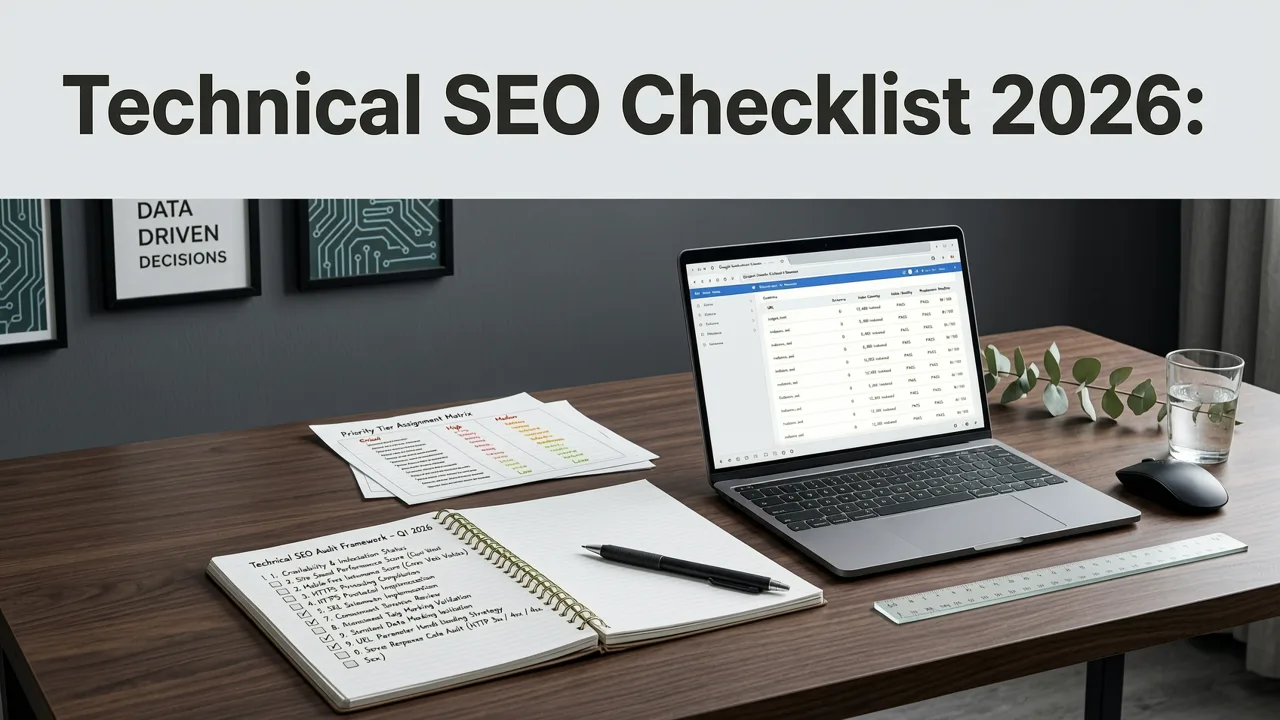
Forget alphabetical checklists. In 2026, technical SEO is no longer about ticking boxes — it’s about managing crawl efficiency, rendering, and indexability. Below is a sensible order for triaging a site — starting with what Googlebot sees first, and ending with what determines long-term ranking resilience.
1. Crawl Readiness & Bot Access Control
Before Googlebot renders a single pixel, it must be able to discover, authenticate, and traverse your site. In 2026, misconfigured access controls remain the #1 cause of unindexed pages — especially on headless or Jamstack deployments.
- Robots.txt validation: Verify syntax using Google’s robots testing tool; ensure
User-agent: *directives don’t accidentally block/js/,/css/, or/api/endpoints required for hydration. - HTTP status integrity: No 4xx/5xx responses in
sitemap.xmlURLs; all canonicals resolve to 200 (not 301 chains >2 hops). - Crawl delay & rate limiting: For high-frequency crawls (>120 req/min), confirm
Crawl-Delayisn’t set in robots.txt unless intentionally throttling — many CMS platforms auto-insert this during staging migrations. - Auth proxy leaks: If using cloudflare workers, Vercel middleware, or Cloud CDN auth layers, test whether
X-Robots-Tag: noindexheaders are being stripped before reaching Googlebot.
2. Indexability Architecture
In 2026, indexability is no longer binary (indexed/not indexed). Google now surfaces partial index coverage in Search Console — flagging pages where only text content is indexed, but structured data, images, or video assets are excluded due to rendering failures.
- Canonical hygiene: All paginated, filtered, and parameterized URLs must declare a self-referencing canonical — even if they’re noindexed. Avoid
rel="canonical"pointing to 301 redirects. - Noindex cascade prevention: Never apply
noindexvia<meta>on templates used across both public and private sections (e.g., blog + member dashboard). Use HTTP headers instead for granular control. - Dynamic parameter handling: Use Google Search Console’s URL Parameters report (now deprecated) — instead, configure
data-paramexclusion rules directly in your sitemap generation logic or viarobots.txtDisallowpatterns matching?ref=,&utm_,&fbclid=.
3. Core Web Vitals & Rendering Integrity
As of Q2 2026, Google has expanded Core Web Vitals to include Hydration Stability Index (HSI) — a new metric measuring how consistently JavaScript-rendered components load without layout shift *after* initial paint. Pages scoring below HSI 0.85 are deprioritized in mobile-first indexing.
- Render-blocking resource audit: Eliminate render-blocking CSS/JS *above the fold* — but also verify that deferred resources don’t trigger late hydration (e.g., lazy-loaded React components that render after CLS window closes).
- SSR/ISR fallbacks: For Next.js, Nuxt, or Astro sites, confirm
getStaticPropsorgenerateStaticParamspre-render all critical product/category pages — not just homepage and blog posts. - Image decoding strategy: Use
decoding="async"on non-critical images; serveloading="lazy"only on elements >1000px below viewport (per updated LCP guidance).
4. Structured Data & Schema Trust Layer
Schema markup is no longer optional for rich results — it’s a prerequisite for topical authority signaling. As of 2026, Google validates cross-entity consistency: if your Product schema declares offers.priceCurrency as “USD”, but your WebPage schema declares inLanguage as “en-GB”, indexing may be delayed until alignment is confirmed.
- JSON-LD placement: Embed
<script type="application/ld+json">in<head>— never inline within<body>unless dynamically injected by trusted client-side logic. - Entity ID consistency: Use stable, persistent URIs (e.g.,
https://example.com/id/product/12345) — not transient slugs — in@idfields across all schema types. - Validation depth: Run schema.org validator against *all* page variants (mobile, AMP, print), not just desktop HTML. Google now tests schema parsing across device-specific render trees.
5. Mobile-First Indexing Compliance
Google uses the mobile version of a site’s content, crawled with its smartphone agent, for indexing and ranking. In 2026, the biggest risk isn’t missing viewport tags — it’s content parity degradation between mobile and desktop versions.
- Dynamic serving verification: Use Google’s URL Inspection Tool to fetch *as Googlebot Smartphone* — then compare rendered text output side-by-side with desktop crawl.
- Touch target sizing: Ensure all interactive elements meet WCAG 2.2 AA standards: minimum 48×48px with 8px separation — validated via Lighthouse v12.3 (2026 baseline).
- Mobile navigation depth: No critical category or product page should require more than 3 taps from the homepage.
6. HTTPS & Security Signal Health
HTTPS remains table stakes — but in 2026, certificate validity windows have tightened. Let’s Encrypt now enforces 45-day renewals, and Googlebot rejects connections with TLS 1.2 cipher suites lacking AEAD encryption (e.g., no more TLS_RSA_WITH_AES_128_CBC_SHA).
- HSTS enforcement: Set
Strict-Transport-Security: max-age=31536000; includeSubDomains; preload— and submit to hstspreload.org (preloading now takes ≤72 hours). - Subresource integrity (SRI): Required for all externally hosted scripts (CDNs, analytics, tag managers); missing SRI hashes trigger ‘untrusted script’ warnings in Search Console.
- HTTP/2 and HTTP/3: Enable modern protocols for faster page loads for visitors. Googlebot can crawl over HTTP/2.
7. XML Sitemap & Index Coverage Strategy
The 2026 sitemap standard isn’t about volume — it’s about intent segmentation. Google now accepts sitemapindex.xml files with <sitemap> entries tagged by <priority> and <lastmod> — and uses these signals to allocate crawl budget per topic cluster.
- Dynamic sitemap generation: Auto-generate separate sitemaps per content type:
products.xml,blog-posts.xml,guides.xml— each with accurate<lastmod>timestamps reflecting actual content updates (not build timestamps). - Index suppression: Exclude thin, templated, or AI-generated pages (e.g., location-based service pages with <50 words) from sitemaps — let them be discovered organically only if linked from high-authority hubs.
- Sitemap size limits: Max 50,000 URLs or 50MB uncompressed — but for sites >1M pages, use hierarchical sitemaps (
sitemap-products-level1.xml,sitemap-products-level2.xml) with logical grouping.
8. URL Structure & Canonical Consistency
URL hygiene affects how efficiently Google crawls your site. Google treats URLs as case sensitive, so /Products/ and /products/ are different URLs. Pick one form, including whether URLs end in a slash (/blog or /blog/), redirect the others to it, and use it in internal links and canonical tags.
- Case normalization: Enforce lowercase-only URLs server-side (via 301 redirect or rewrite rule); avoid relying on case-insensitive filesystems.
- Trailing slash policy: Choose one convention and enforce globally — either always append (for directories) or never (for resources). Document in
hreflangand canonical links. - Parameter stripping: Strip tracking parameters (
?source=,&campaign=) *before* canonical resolution — don’t let them leak into canonical URLs.
9. Internal Link Architecture & Equity Flow
Internal links help Google find your pages and understand how they relate. Link each important page from its hub page and from related articles, so nothing you care about is buried many clicks deep.
- Pillar-cluster mapping: Audit internal links to ensure every product page links to at least one category guide, and every guide links to ≥2 relevant products — with descriptive, intent-aligned anchor text (not ‘click here’).
- Orphan page elimination: Identify pages with zero internal links *and* no external backlinks — these are prime candidates for consolidation or 301 redirects into stronger siblings.
- Nofollow discipline: Reserve
rel="nofollow"only for paid links, untrusted UGC, or login/checkout flows — never for pagination, filters, or sitewide footers.
10. AI-Generated Content Transparency
Google doesn’t require AI disclosures, but its guidance on generative AI content says that sharing how a piece of content was created “can help give your readers more context”.
- Disclosure where readers expect it: If readers might wonder how a page was made, say so in a short note near the byline or at the end of the article.
- Author attribution: Point the
authorfield in your schema to a real person (not ‘Editorial Team’), and link to a bio page that shows their experience. - Human review: Have someone who knows the topic check facts and sources before publishing, and update
dateModifiedonly when the content really changes.
11. Local SEO Technical Foundations (For Multi-Location Brands)
Local pack eligibility now requires technical signals beyond GMB. In 2026, Google cross-references LocalBusiness schema, NAP consistency *in HTML text* (not just JSON-LD), and geo-IP-resolved hreflang declarations.
- Location page uniqueness: Each city/region page must contain ≥200 words of location-specific content (e.g., neighborhood references, local events, service area maps) — templated placeholders trigger ‘duplicate content’ flags.
- Geo-hreflang: Declare
hreflang="en-us-x-sf"for San Francisco pages,hreflang="en-us-x-nyc"for NYC — using ISO 3166-2 subtags, not just country codes. - Structured NAP in visible text: Display full business name, address, phone *in plain HTML* (not images or SVG) — Google now parses visible text for local ranking signals, not just schema.
12. Monitoring, Alerting & Regression Prevention
A checklist is useless without continuous validation. In 2026, we treat technical SEO like infrastructure monitoring — with automated baselines, anomaly detection, and rollback triggers.
- Automated crawl health dashboard: Track daily: % of 200s vs 4xx/5xx, avg. time-to-first-byte (TTFB) by device, JS hydration success rate (via Puppeteer + Lighthouse CI).
- Index coverage delta alerts: Set Slack/email alerts for >5% daily drop in indexed pages — correlated with deploy timestamps to catch config regressions.
- Pre-deploy validation: Run technical SEO linting (e.g., our AI-powered on-page auditor) against staging environments — blocking merges that introduce broken canonicals, missing schema, or render-blocking JS.
How This Technical SEO Checklist 2026 Fits Into Your Growth Strategy

A flawless technical foundation doesn’t guarantee rankings — but it removes the ceiling. As we detail in our guide on how to increase organic search traffic in 2026, technical health is step one in a three-layer framework: fix foundations → build intent architecture → publish E-E-A-T-aligned content. Without layer one, layers two and three operate at diminished ROI.
Final Thoughts: Technical SEO Is Now a Continuous Discipline
In 2026, technical SEO is no longer a ‘one-time audit’ project. It’s a live system — integrated into development workflows, monitored like uptime, and optimized alongside performance and security. The checklist above isn’t an endpoint — it’s your operational north star.
If you’re scaling fast, managing complex tech stacks, or preparing for algorithm shifts later this year (including Google’s rumored ‘Topical Trust Refresh’ expected Q4 2026), consider partnering with a team that treats technical SEO as infrastructure — not an afterthought. Let’s audit your crawl health and map your 2026 technical roadmap.


